LabMedica

Download Mobile App
Recent News Expo Clinical Chem. Molecular Diagnostics Hematology Immunology Microbiology Pathology Technology Industry Focus

Blood Test Developed to Indicate Breast Cancer Risk

By LabMedica International staff writers
Posted on 10 Jul 2014
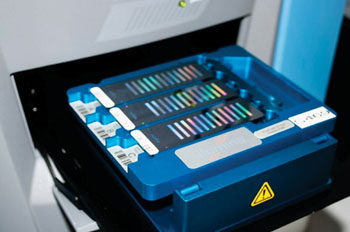
Infinium Human Methylation BeadChip
Illumina’s Infinium Human Methylation BeadChip Kits (Photo courtesy of Illumina)
A simple blood test to help predict the likelihood of a woman developing breast cancer has been developed, as the idea that genetic mutations are the sole contributors to the development of the disease is changing.

Extensive genome-wide association studies have identified a number of single nucleotide polymorphisms (SNPs) associated with breast cancer risk whereas a gene mutation associated DNA methylation signature in blood cells could predict sporadic breast cancer incidence and survival.

Scientists at the University College London (UK) and their colleagues analyzed whole blood samples from two cohorts of breast cancer 1, early onset (BRCA1) gene mutation carriers and controls without a BRCA1 mutation. A total of 152 women, 75 cancer cases and 77 controls, were selected from those who provided both a peripheral blood and a buccal cell sample at the age of 53 in 1999, who had not previously developed any cancer.

The DNA from whole blood and tissues was extracted and DNA methylation analysis was performed using the validated Infinium Human Methylation BeadChip (Illumina; San Diego, CA, USA) or Illumina’s Infinium Human Methylation450 BeadChip kit. The methylation status of a specific CpG site, where a cytosine nucleotide occurs next to a guanine nucleotide, was calculated from the intensity of the methylated (M) and unmethylated (U) alleles, as the ratio of fluorescent signals.

The team analyzed DNA methylation (DNAme) of 27,578 CpGs in white blood cell (WBC) samples from a total of 72 women with a known BRCA1 mutation and 72 women with no mutation in the BRCA1 or BRCA2 gene. The scientists found that the women who developed both hereditary and non-hereditary breast cancer shared the same signature. The investigators believe that the epigenetic signature may be responsible for silencing genes in immune cells and if these genes are silenced, then the immune system may be less able to prevent the development of breast cancer.

Martin Widschwendter, MD, a professor of Gynecological Oncology and lead author of the study, said, “We identified an epigenetic signature in women with a mutated BRCA1 gene that was linked to increased cancer risk and lower survival rates. Surprisingly, we found the same signature in large cohorts of women without the BRCA1 mutation and it was able to predict breast cancer risk several years before diagnosis. The data is encouraging since it shows the potential of a blood-based epigenetic test to identify breast cancer risk in women without known predisposing genetic mutations.” The study was published on June 27, 2014, in the journal Genome Medicine.

Related Links:

University College London 
Illumina 


Gold Member
Fibrinolysis Assay

HemosIL Fibrinolysis Assay Panel
POC Helicobacter Pylori Test Kit
Hepy Urease Test
Sperm Quality Analyis Kit
QwikCheck Beads Precision and Linearity Kit
Automatic CLIA Analyzer
Shine i9000
Read the full article by registering today, it's FREE! It's Free!
Register now for FREE to LabMedica.com and get access to news and events that shape the world of Clinical Laboratory Medicine.
  • Free digital version edition of LabMedica International sent by email on regular basis
  • Free print version of LabMedica International magazine (available only outside USA and Canada).
  • Free and unlimited access to back issues of LabMedica International in digital format
  • Free LabMedica International Newsletter sent every week containing the latest news
  • Free breaking news sent via email
  • Free access to Events Calendar
  • Free access to LinkXpress new product services
  • REGISTRATION IS FREE AND EASY!
Click here to Register


Channels

Immunology

view channel
Image: Circulating tumor cells isolated from blood samples could help guide immunotherapy decisions (Photo courtesy of Shutterstock)

Blood Test Identifies Lung Cancer Patients Who Can Benefit from Immunotherapy Drug

Small cell lung cancer (SCLC) is an aggressive disease with limited treatment options, and even newly approved immunotherapies do not benefit all patients. While immunotherapy can extend survival for some,... Read more

Microbiology

view channel
Image: New evidence suggests that imbalances in the gut microbiome may contribute to the onset and progression of MCI and Alzheimer’s disease (Photo courtesy of Adobe Stock)


Comprehensive Review Identifies Gut Microbiome Signatures Associated With Alzheimer’s Disease

Alzheimer’s disease affects approximately 6.7 million people in the United States and nearly 50 million worldwide, yet early cognitive decline remains difficult to characterize. Increasing evidence suggests... Read more

Technology

view channel
Image: Vitestro has shared a detailed visual explanation of its Autonomous Robotic Phlebotomy Device (photo courtesy of Vitestro)

Robotic Technology Unveiled for Automated Diagnostic Blood Draws

Routine diagnostic blood collection is a high‑volume task that can strain staffing and introduce human‑dependent variability, with downstream implications for sample quality and patient experience.... Read more

Industry

view channel
Image: Roche’s cobas® Mass Spec solution enables fully automated mass spectrometry in routine clinical laboratories (Photo courtesy of Roche)

New Collaboration Brings Automated Mass Spectrometry to Routine Laboratory Testing

Mass spectrometry is a powerful analytical technique that identifies and quantifies molecules based on their mass and electrical charge. Its high selectivity, sensitivity, and accuracy make it indispensable... Read more