LabMedica

Download Mobile App
Recent News Expo Clinical Chem. Molecular Diagnostics Hematology Immunology Microbiology Pathology Technology Industry Focus

Immunoassay Detects Specific Antibodies in Antiphospholipid Syndrome Patients

By LabMedica International staff writers
Posted on 15 Jun 2015
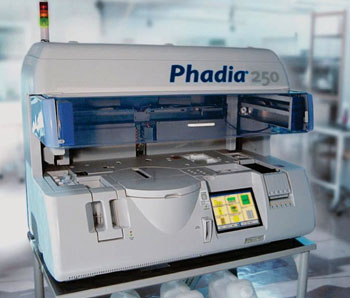
The Phadia 250 Immunoassay Analyzer
The Phadia 250 Immunoassay Analyzer (Photo courtesy of )
Currently, enzyme-linked immunosorbent assays (ELISA) for detection of anticardiolipin (aCL) and anti-β2glycoprotein I (anti-β2GPI) antibodies has not been standardized.

Antiphospholipid (aPL) antibodies are a heterogeneous group of autoantibodies directed against plasma protein-phospholipid complexes or single plasma proteins and their presence in patients with thrombosis and/or pregnancy morbidity defines antiphospholipid syndrome.

Scientists at the University of Padova (Italy) collected blood samples from 94 primary antiphospholipid syndrome (PAPS) patients (84 females and 10 males, mean age 44.3 ± 11.7 years, range 20 to 79) who fulfilled the classification criteria for definite antiphospholipid syndrome. Forty-three had a history of thrombosis, 38 of pregnancy morbidity, and 13 of both thrombosis and pregnancy morbidity.

Serum immunoglobulin G/M (IgG/IgM) aCL/anti-β2GPI antibodies were determined using a fluorescence enzyme immunoassay (FEIA-EliA, Phadia AB; Uppsala, Sweden) and an in-house ELISA. The fluorescence in the reaction mixture was measured using the Phadia 250 instrument. Higher fluorescent signal values corresponded to larger quantities of antibodies binding to the antigens. IgG/IgM aCL and IgG/IgM anti-β2GPI ELISA assays were performed using a home-made method following the European Forum on antiphospholipid (aPL) recommendations.

The sensitivities of the two methods were similar with the exception of IgM aCL which was found to be significantly higher in the PAPS patients using the ELISA method, even if IgM aCL was detected at a low level by both techniques. The two assays had a comparable specificity, a high/significant agreement and a significant correlation between the antibody levels. FEIA testing uncovered no significant prevalence of any antiphospholipid (aPL) antibody in the ELISA negative patients.

The authors concluded that FEIA, like other fully automated systems, may be considered as a useful assay for laboratories with a large number of samples and moreover, it reduces operator handling, pipetting errors and differences in protocols. The results of the study support FEIA's routine use in detecting aCL and anti-β2GPI antibodies. The study was published in the June 2015 issue of the journal Clinica Chimica Acta.

Related Links:

University of Padova 
Phadia AB  

New
Gold Member
Clinical Drug Testing Panel
DOA Urine MultiPlex
POC Helicobacter Pylori Test Kit
Hepy Urease Test
Gold Member
Hematology Analyzer
Medonic M32B
Gel Cards
DG Gel Cards
Read the full article by registering today, it's FREE! It's Free!
Register now for FREE to LabMedica.com and get access to news and events that shape the world of Clinical Laboratory Medicine.
  • Free digital version edition of LabMedica International sent by email on regular basis
  • Free print version of LabMedica International magazine (available only outside USA and Canada).
  • Free and unlimited access to back issues of LabMedica International in digital format
  • Free LabMedica International Newsletter sent every week containing the latest news
  • Free breaking news sent via email
  • Free access to Events Calendar
  • Free access to LinkXpress new product services
  • REGISTRATION IS FREE AND EASY!
Click here to Register


Channels

Molecular Diagnostics

view channel
Image: The diagnostic device can tell how deadly brain tumors respond to treatment from a simple blood test (Photo courtesy of UQ)

Diagnostic Device Predicts Treatment Response for Brain Tumors Via Blood Test

Glioblastoma is one of the deadliest forms of brain cancer, largely because doctors have no reliable way to determine whether treatments are working in real time. Assessing therapeutic response currently... Read more

Microbiology

view channel
Image: New evidence suggests that imbalances in the gut microbiome may contribute to the onset and progression of MCI and Alzheimer’s disease (Photo courtesy of Adobe Stock)

Comprehensive Review Identifies Gut Microbiome Signatures Associated With Alzheimer’s Disease

Alzheimer’s disease affects approximately 6.7 million people in the United States and nearly 50 million worldwide, yet early cognitive decline remains difficult to characterize. Increasing evidence suggests... Read more

Technology

view channel
Image: Vitestro has shared a detailed visual explanation of its Autonomous Robotic Phlebotomy Device (photo courtesy of Vitestro)

Robotic Technology Unveiled for Automated Diagnostic Blood Draws

Routine diagnostic blood collection is a high‑volume task that can strain staffing and introduce human‑dependent variability, with downstream implications for sample quality and patient experience.... Read more

Industry

view channel
Image: Roche’s cobas® Mass Spec solution enables fully automated mass spectrometry in routine clinical laboratories (Photo courtesy of Roche)

New Collaboration Brings Automated Mass Spectrometry to Routine Laboratory Testing

Mass spectrometry is a powerful analytical technique that identifies and quantifies molecules based on their mass and electrical charge. Its high selectivity, sensitivity, and accuracy make it indispensable... Read more