Binding Site Unveils Optilite Protein System
|
By LabMedica International staff writers Posted on 09 Feb 2017 |


|
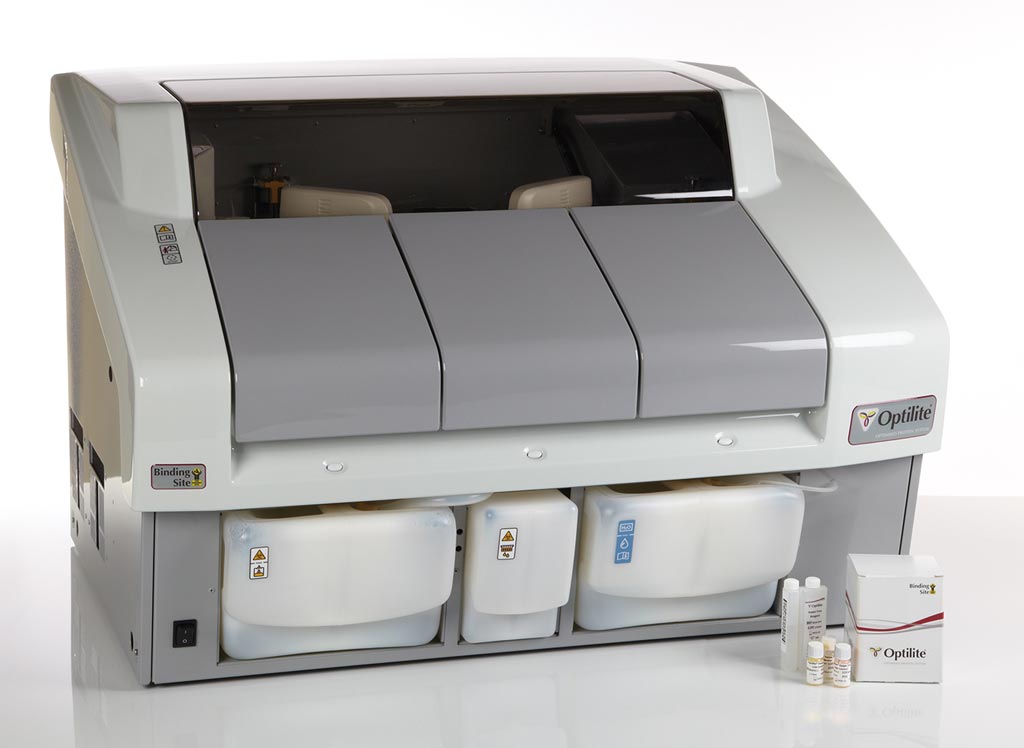
Image: The Optilite protein system (Photo courtesy of The Binding Site).
The Binding Site, which provides specialist diagnostic products to clinicians and laboratory professionals worldwide, launched its new optimized protein system, Optilite in the Middle East, at MEDLAB 2017, the world’s largest laboratory exhibition and congress in the region.
Binding Site focuses on research, development, manufacture and distribution of immunodiagnostic systems and assays for the global laboratory market. By utilizing its specialized expertise in antibody specificity technology, it has developed a broad menu of special protein assays. Binding Site gives clinicians and laboratory staff the tools to significantly improve diagnosis and management of patients with specific cancers and immune disorders.
The company has designed Optilite, a dedicated benchtop special protein analyzer, specifically for laboratory workflow optimization. Optilite’s continuous loading of samples, reagents, and consumables plus automatic re-dilution to end result enable labs to maximize test throughput while minimizing hands-on time. With a compact benchtop design, Optilite is quick to install, easy to maintain, and is equipped with full LIS connectivity and automatic barcode recognition for full traceability. Unique to Optilite is a robust antigen excess protection system with three detection methods, thereby ensuring accurate and reliable results.







Binding Site focuses on research, development, manufacture and distribution of immunodiagnostic systems and assays for the global laboratory market. By utilizing its specialized expertise in antibody specificity technology, it has developed a broad menu of special protein assays. Binding Site gives clinicians and laboratory staff the tools to significantly improve diagnosis and management of patients with specific cancers and immune disorders.
The company has designed Optilite, a dedicated benchtop special protein analyzer, specifically for laboratory workflow optimization. Optilite’s continuous loading of samples, reagents, and consumables plus automatic re-dilution to end result enable labs to maximize test throughput while minimizing hands-on time. With a compact benchtop design, Optilite is quick to install, easy to maintain, and is equipped with full LIS connectivity and automatic barcode recognition for full traceability. Unique to Optilite is a robust antigen excess protection system with three detection methods, thereby ensuring accurate and reliable results.

Platinum Member
Automated Coagulation Analyzer
Hemolumi H6
Gold Member
Blood-Based Protein Biomarker Solution for Alzheimer's Disease
BG-DTi2000.
New
MR-proADM Test
B•R•A•H•M•S MR-proADM KRYPTOR test
New
Drug Testing Assays
Atellica DT 250 Analyzer
Latest MEDLAB 2017 News
- AXA Diagnostics Showcases SkyLAB752 ELISA Analyzer
- Norma Diagnostika Showcases Icon Hematology Analyzers at MEDLAB
- AITbiotech Exhibits abTES Molecular Diagnostics Assays at MEDLAB 2017
- Das SRL Exhibits New Lab Solutions at MEDLAB 2017
- Priorclave Showcases Energy-Efficient Lab Autoclaves in Dubai
- Diatron Exhibits Abacus 5 and Aquila Hematology Analyzers
- DRG Group Presents New Analyzer and ELISAs at Dubai Lab Exhibition
- Beckman Coulter Exhibits New Lab Solutions in Dubai
- Siemens Healthineers Showcases Latest Diagnostic Innovations
Channels
Clinical Chemistry
view channel
Breath Analysis Shows Promise for Distinguishing Cancerous from Benign Lung Nodules
Lung nodules are frequently detected during imaging, but distinguishing malignant from benign findings can require invasive procedures. Some patients undergo biopsies, bronchoscopy, or surgery before learning... Read more
Blood Biomarker Patterns Could Support Monitoring of Anti-Amyloid Treatment
Patients with early-stage Alzheimer’s disease may receive anti-amyloid therapy to clear amyloid protein deposits from the brain. These treatments can slow disease progression, but they do not cure the... Read more
Prehospital Blood Test Could Reduce Emergency Transfers for Chest Pain
Chest pain leads to ambulance transport to an emergency department for about 95% of patients, although only a minority have a serious cardiac condition. Troponin testing helps assess heart muscle damage,... Read more
First-of-Its-Kind Rapid Blood Test Gains CE Mark to Support Prehospital Stroke Triage
Rapid stroke identification before hospital arrival is critical because treatment efficacy declines with every minute of delay. However, definitive assessment typically requires hospital-based imaging,... Read moreMolecular Diagnostics
view channel
Long-Read Sequencing Test Identifies Genetic Causes in Inherited Muscle Disease
Inherited muscle diseases are highly heterogeneous and often progressive, leaving many patients without a molecular diagnosis despite extensive testing. Conventional assays typically target individual... Read more
Genomic Test Guides Extended Endocrine Therapy in Early Breast Cancer
Adjuvant endocrine therapy is standard for hormone receptor–positive early breast cancer, yet prolonged treatment brings side effects and adherence problems. Whether to continue beyond five years is a... Read more

Hematology
view channel
New Donor Genetic Marker May Help Predict Stem Cell Transplant Success
Donor selection for hematopoietic stem cell transplantation plays a major role in relapse risk and survival for patients with blood cancers and other blood disorders. Despite advances in genotyping, uncertainty... Read more
Updated Ferritin Thresholds Improve Detection of Iron Deficiency
Iron deficiency is one of the most common health conditions worldwide, yet its nonspecific symptoms can delay diagnosis for months. Variation in testing practices and ferritin thresholds may contribute... Read more

Immunology
view channel
HIV Monitoring Strategy Uses Drug Levels to Guide Resistance Testing
HIV viral load can rise during antiretroviral therapy for reasons that do not necessarily indicate drug resistance. Clinicians must distinguish between treatment nonadherence and resistance before deciding... Read more
Werfen Expands Automated APS Testing with FDA-Cleared and CE-Marked IgA Reagent
Antiphospholipid syndrome (APS) is an autoimmune disorder associated with thrombosis and pregnancy complications, but its symptoms can overlap with those of other conditions, complicating diagnosis.... Read more
Blood Biomarker May Predict Colitis Risk in Checkpoint Inhibitor Therapy
Immune checkpoint inhibitors can trigger immune-related colitis that leads to severe diarrhea, abdominal pain, and treatment interruptions. Clinicians currently lack validated tools to identify which patients... Read more
Blood EBV Activity Biomarkers May Predict Multiple Sclerosis Relapse Months Ahead
Predicting relapse in multiple sclerosis (MS) remains difficult, limiting opportunities for timely intervention and monitoring. Although many people harbor latent Epstein-Barr virus (EBV), growing evidence... Read moreMicrobiology
view channel
One-Hour Molecular Panel Expands Bloodstream Infection Testing for Gram-Negative Pathogens
Bloodstream infections can progress rapidly and lead to sepsis, organ failure, and death. In the United States, about 1.7 million adults develop sepsis each year, and at least 350,000 die during hospitalization... Read more
FDA Clears Rapid Phenotypic Antimicrobial Susceptibility System for Positive Blood Cultures
Bloodstream infections require prompt treatment, but antimicrobial susceptibility results often lag behind a positive blood culture. Conventional testing can take another 24 to 48 hours after a culture... Read more
New Urine Test Expands Mycotoxin Analysis to 31 Markers for Broader Exposure Assessment
Clinical evaluation of mold exposure increasingly relies on urinary mycotoxin testing, but limited marker coverage and metabolite masking can make results more difficult to interpret. Broader analysis... Read more
Pathology
view channel
New AI Model Maps Where Glioblastoma Could Return After Surgery
Glioblastoma is the most common malignant brain tumor in adults and the most lethal, with median survival of about 17 months after diagnosis. Even after surgeons remove all visible tumor and patients receive... Read more
Multimodal AI Supports Prostate Cancer Risk Assessment Across Diverse Cohorts
Artera’s (Los Altos, CA, USA) multimodal artificial intelligence (MMAI) platform is being featured in five abstracts at the American Society for Radiation Oncology (ASTRO) 2026 Annual Meeting.... Read more

Technology
view channel
New Automation Workflow Streamlines NGS Library Preparation for High-Volume Labs
Demand for next-generation sequencing (NGS) continues to rise as laboratories process growing sample volumes, yet library preparation remains labor-intensive and a frequent source of variability.... Read more
ADLM Calls for CLIA Updates to Support Safe AI Use in Laboratory Medicine
Clinical laboratories increasingly use artificial intelligence to verify, interpret, and report results, but safeguards under the Clinical Laboratory Improvement Amendments (CLIA) were designed in 1992.... Read more
Industry
view channel
Collaboration Combines AI Cognitive Assessment and RNA Blood Testing for Earlier Alzheimer’s Detection
Alzheimer’s disease is often identified only after substantial neurodegeneration, partly because current diagnostic pathways are fragmented and difficult to scale. As treatment shifts toward earlier intervention,... Read more
Mayo Clinic Laboratories and Pathology Asia Expand Genomic Testing Across Asia-Pacific
Mayo Clinic Laboratories and Pathology Asia Holdings (PAH), together with subsidiary LifeStrands Genomics, announced a strategic investment and collaboration focused on expanding access to advanced diagnostics... Read more