Cancer-Related Mutations in Immune Cells Linked to Alzheimer’s
Posted on 24 Apr 2026
Alzheimer’s disease is marked by protein aggregation and inflammatory changes in the brain’s immune system, yet its molecular drivers remain incompletely understood. With aging, human cells accumulate DNA alterations that can influence cellular behavior. Determining whether these mutations contribute to neurodegeneration could inform risk stratification and therapeutic strategies. A new study shows that cancer-driver mutations in microglia, detectable in blood, are associated with Alzheimer’s pathology.
Researchers at Boston Children’s Hospital focused on microglia, the brain’s resident immune cells that act as “garbage collectors,” clearing debris and damaged or dying cells. Unlike circulating immune cells, microglia have long been thought to remain confined behind the blood-brain barrier. Using donated tissue, the team sequenced 149 cancer-driver genes from 190 brains with Alzheimer’s disease and 121 healthy brains, finding that Alzheimer’s samples carried more single-letter DNA changes than controls. The most frequent alterations recurred in the same five cancer driver genes, indicating selection for specific variants within microglia.
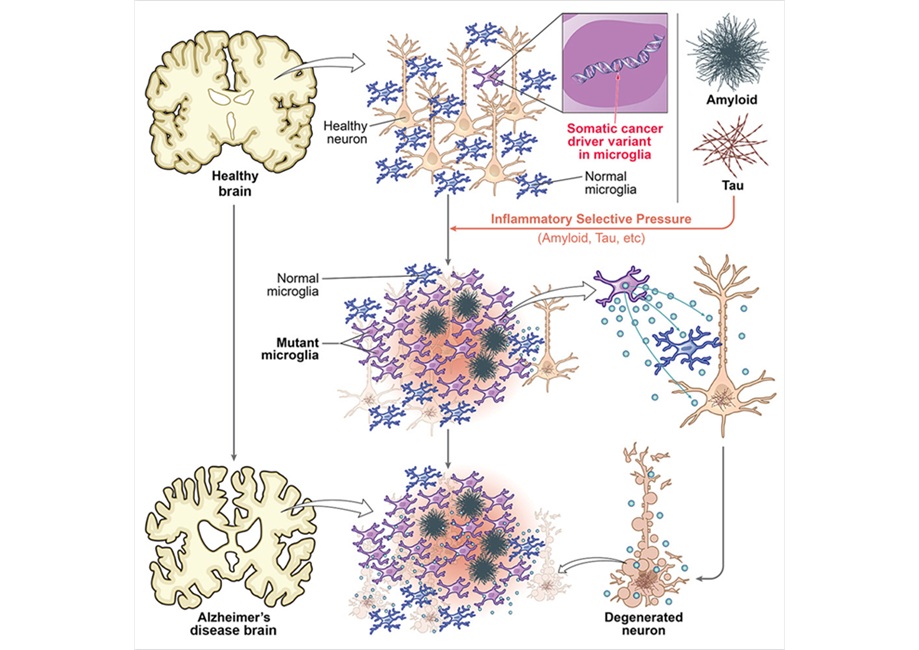
Because these mutations are commonly seen in blood cancers, the investigators analyzed matched blood samples from patients with Alzheimer’s disease. Unexpectedly, they identified the same cancer-driver mutations in circulating blood cells. The findings challenge the long-held view that microglia do not originate from outside the brain. The researchers propose that age- or injury-related weakening of the blood-brain barrier allows peripheral immune cells to enter the brain, where they adopt microglia-like properties.
In the presence of accumulating tau or amyloid aggregates, these mutation-bearing cells may gain a selective advantage and expand. The authors suggest that such mutant microglia create a more inflammatory environment that contributes to bystander neuronal loss and disease progression.
The study was published in Cell on April 21, 2026. A follow-up analysis posted to bioRxiv reported that cancer-driver mutations detected in patient blood increased Alzheimer’s risk independently of the well-established genetic factor APOE4. Institutional collaborators included Harvard Medical School, Broad Institute of MIT and Harvard, and the Howard Hughes Medical Institute. The findings may inform development of new diagnostics and treatments, and the authors note that blood-based genetic screening could be feasible because brain tissue is difficult to access in living patients.
“We find that to some extent, Alzheimer’s disease is a little like cancer—driven by the same mutations that drive blood cancers like lymphoma and leukemia. This is helpful because we have a lot of drugs to fight cancer and some of them might be useful therapeutically for Alzheimer’s disease,” said Christopher Walsh, Chief of the Division of Genetics and Genomics at Boston Children’s Hospital and an Investigator of the Howard Hughes Medical Institute.
“It was actually a really unexpected finding that suggests a totally new mechanism for Alzheimer’s disease pathogenesis. The findings mean that the blood’s immune cells with cancer mutations are likely getting into the brain and contributing to disease,” said August Yue Huang, Division of Genetics and Genomics, Boston Children’s Hospital, and Professor at Harvard Medical School.
Related Links
Boston Children’s Hospital





.jpg)