Light-Based Sensor Detects Early Molecular Signs of Cancer in Blood
Posted on 17 Feb 2026
Early cancer diagnosis is often hindered by the extremely low concentration of biomarkers present at the onset of disease. Proteins, DNA fragments, and other molecular markers can reveal cancer risk or progression, but detecting them typically requires complex amplification techniques. These steps can be time-consuming, costly, and difficult to implement for routine screening. Researchers have now developed a highly sensitive light-based sensor capable of detecting cancer biomarkers directly from blood at ultra-low concentrations.
The nanoscale sensor developed by researchers at Shenzhen University (Shenzhen, China) combines DNA nanostructures, quantum dots, and CRISPR-Cas gene-editing technology with a nonlinear optical technique known as second harmonic generation. The system uses DNA tetrahedrons to position quantum dots precisely above a molybdenum disulfide surface, enhancing local optical fields. When CRISPR-Cas12a recognizes a specific biomarker, it cuts the DNA scaffold, causing a measurable drop in the SHG signal and enabling direct, amplification-free detection.
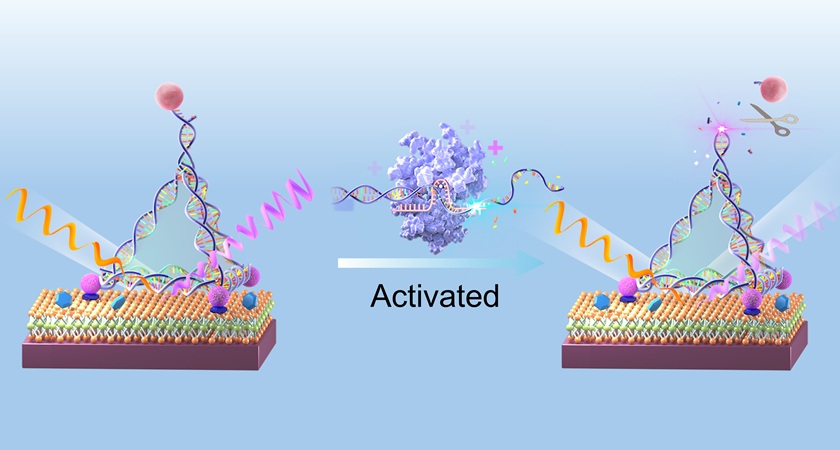
Researchers demonstrated that the sensor could detect the lung cancer–associated microRNA miR-21 at sub-attomolar levels, producing a clear signal even when only a few molecules were present. The technique showed minimal background noise and high specificity, distinguishing the target from similar RNA strands. The findings, published in Optica, confirmed that the sensor also worked in human serum samples from lung cancer patients, simulating real-world blood testing conditions.
The programmable design allows adaptation of the platform to detect viruses, bacteria, environmental toxins, and biomarkers linked to other diseases, including Alzheimer’s. Researchers suggest the method could support early cancer screening before tumors are visible on imaging and enable frequent monitoring of treatment response. The next steps include miniaturizing the optical setup to create a portable device suitable for bedside use, outpatient clinics, or low-resource settings, expanding access to precision diagnostics.
“For early diagnosis, this method holds promise for enabling simple blood screenings for lung cancer before a tumor might be visible on a CT scan,” said research team leader Han Zhang from Shenzhen University. “It could also help advance personalized treatment options by allowing doctors to monitor a patient’s biomarker levels daily or weekly to assess drug efficacy, rather than waiting months for imaging results.”
Related Links:
Shenzhen University