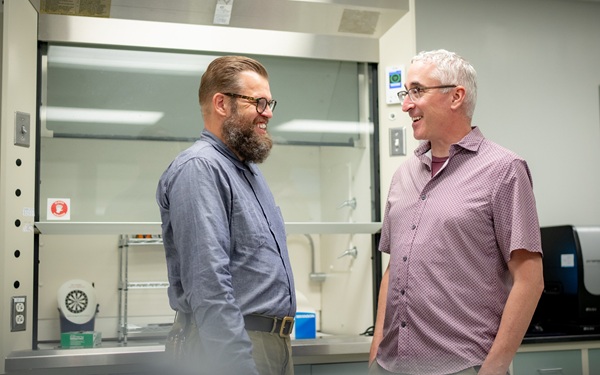
Genetic Mutation Can Double Prostate Cancer Risk
By Biotechdaily staff writers
Posted on 15 Nov 2002
A study has shown that a relatively common genetic mutation could double the risk of prostate cancer in some men. Posted on 15 Nov 2002
Results of the study suggest that up to 13% of prostate cancer cases are attributable to a mutation of the RNASEL gene known as R462Q, which makes R462Q one of the most frequent genetic alterations in any of the common cancers. Mutations of the widely known BRCA1 gene, in comparison, account for less than 5% of breast and ovarian cancers. RNASEL is a protein produced by normal cells that can lead to cell death,
including the death of cancer cells. When RNASEL is mutated, one of the brakes to uncontrolled cell growth is removed, which in turn leads to the development of cancer.
In the study, nearly 60% of 877 men possessed at least one copy of the R462Q variant. Men who inherited only one copy of the mutation from a parent had a 50% increased risk of prostate cancer, while those who inherited two copies, one from each parent, had a two-fold increased risk of the disease.
"This means that while the effect of carrying the R462Q variant may be relatively small for a given individual, the effect on men's health overall is very large because of the frequency of the R462Q variant in the population,” said Dr. Graham Casey, Ph.D., one of the study's authors, of the Cleveland Clinic (OH, USA). "These findings suggest that screening men for this mutation may be justified in future risk assessment of prostate cancer.”
Studies at the Cleveland Clinic Lerner Research Institute indicate that the R462Q variant cripples the normal function of RNASEL but does not stop it from working altogether. As a result, its effectiveness in preventing uncontrolled cell growth is weakened, thereby increasing the chances of a cell turning cancerous. The current study was conducted by researchers from The Cleveland Clinic, Washington University, and the US National Institutes of Health.
Related Links:
Cleveland Clinic




Platinum Member

Automated Coagulation Analyzer
Hemolumi H6
Gold Member

Quantitative POC Immunoassay Analyzer
EASY READER+

LAIR2 Antibody Pair Set
LAIR2 Antibody Pair [Biotin]

Portable POCT Blood Gas Analyzer
BD100