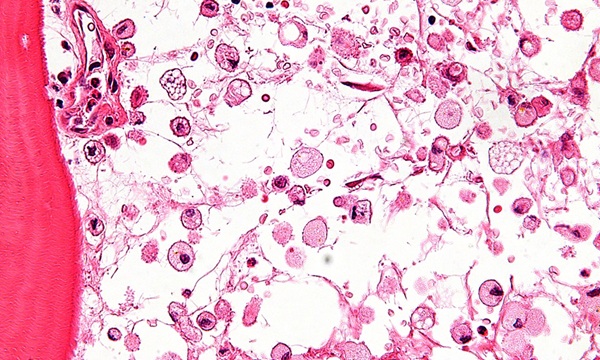
Cancer Vaccines May Free Patients from Long-Term Chemotherapy
By LabMedica International staff writers
Posted on 19 Jan 2010
A novel vaccine destroys the drug resistant cancer stem cells that persist in patients with chronic myeloid leukemia (CML) who have undergone long-term treatment with the drug imatinib mesylate (IM).Posted on 19 Jan 2010
While CML initially responds to IM treatment, most patients eventually suffer relapse due to the persistence of a population of drug resistant cancer stem cells. This problem may be resolved, however, through the use of a novel vaccine described in a paper published in the January 1, 2010, issue of the journal Clinical Cancer Research.
In this paper, investigators at Johns Hopkins University (Baltimore, MD, USA) described the development and use of a vaccine made from genetically modified and irradiated CML cells. In the study, the vaccine was administered to 19 CML patients who demonstrated measurable numbers of persistent cancer cells despite taking IM for at least one year. Each patient was given a series of four injections administered at three-week intervals while remaining on a stable dose of imatinib mesylate.
Results showed that 13 patients had a progressive decline in disease burden, 8 of whom had increasing disease burden before vaccination. Twelve patients achieved their lowest tumor burden measurements to date following vaccine, including seven subjects whose cancer cell burden became undetectable.
Most CML patients require permanent IM therapy. However, while more than 90% of them will achieve remission, about 10 to 15% cannot tolerate the drug long term. Side effects of the drug include low blood cell counts, fluid retention, significant nausea, and other gastrointestinal problems
"We want to get rid of every last cancer cell in the body, and using cancer vaccines may be a good way to mop up residual disease," said senior author Dr. Hyam Levitsky, professor of oncology, medicine, and urology at Johns Hopkins University. "Ultimately, should this vaccine approach prove to be successful, the ability to get patients off lifelong IM therapy would be a significant advance."
Related Links:
Johns Hopkins University




Platinum Member

Automated Coagulation Analyzer
Hemolumi H6
Gold Member

Electrolyte Analyzer
CBS-4000 (CBS-400)
New

Drug Testing Assays
Atellica DT 250 Analyzer

Thyroid Test
Anti-Thyroid EIA Test