Regeneration of Damaged Muscle Tissue Depends on Cyclin-dependent Kinase 9
By Biotechdaily staff writers
Posted on 08 Jul 2008
Posted on 08 Jul 2008
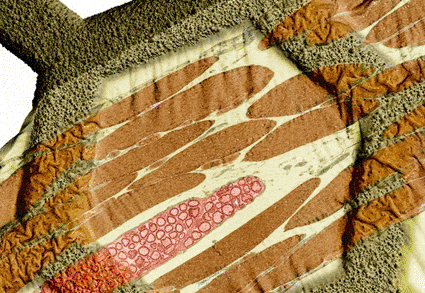
Image: Colored scanning electron micrograph (SEM) of an ultrathin section of tissue containing muscle (brown) and nerves (pink) supported on a transmission electron micrograph (TEM) octagonal grid (Photo courtesy of Steve Gschmeissner / SPL).
Healing of muscle tissue begins with the activation of satellite cells (myogenic stem cells). The satellite cells abandon their normal quiescent state, proliferate with activation of MyoD and Myf-5 gene expression, and finally differentiate and fuse to reconstitute the injured muscle architecture. Previous studies had shown that cdk9 (cyclin-dependent kinase 9) was required to activate MyoD.
In the current work, which was published in the June 10, 2008, issue of the Journal of Cellular Physiology, investigators at Temple University (Philadelphia, PA, USA) found that cdk9-55, a variation of the cdk9 gene, was induced specifically when satellite cells began differentiation and was necessary for the genetic reprogramming required to complete the muscle tissue regeneration process.
Furthermore, cdk9-55 could be used to increase the cell mass in healthy muscle tissue.
"This discovery has important implications for tissue regeneration in muscle tissue damaged by disease and injury, genetic disorders such as muscular dystrophy, chronic disorders like cancer or HIV that may impair muscle regeneration, and diseases related to aging,” said senior author Dr. Antonio Giordano, professor of biology at Temple University.
Related Links:
Temple University




Platinum Member

Automated Coagulation Analyzer
Hemolumi H6

Gold Member

Platelet Function Analyzer
PL-12

Manual Pipetting Aid
Pipette Controllers macro
New

MR-proADM Test
B•R•A•H•M•S MR-proADM KRYPTOR test