Mechanism Explains Why Females Do Not Make Twice as Much Protein as Males
By Biotechdaily staff writers
Posted on 16 Jun 2008
Posted on 16 Jun 2008
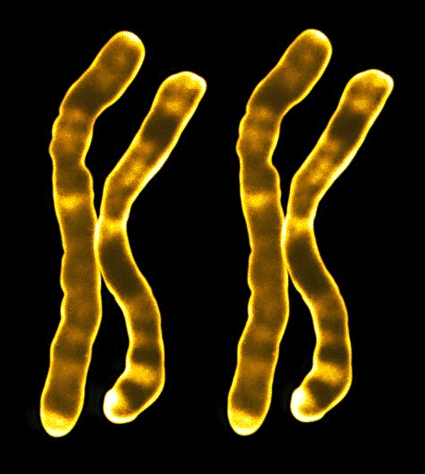
Image: Colored light micrograph of the two X chromosomes of a human female (Photo courtesy of the Department of Clinical Cytogenetics, Addenbrookes Hospital).
Investigators at the European Molecular Biology Laboratory (Heidelberg, DE) and at the EMBL-European Bioinformatics Institute (Hinxton, UK) concentrated on the MSL protein complex, which had been shown previously to mediate dosage compensation in the fruit fly.
They reported in the June 2008 issue of the journal Cell that a protein called MOF, which is the histone H4 lysine 16 (H4K16) specific histone acetyltransferase, is the active component of MSL. MOF's mode of action was traced to differential binding behavior depending on whether the target gene was located on the X chromosome or on the autosomes. On autosomes and the X chromosome in females, MOF bound mostly to the beginning of the gene where transcription starts. On the X chromosome in males, however, MOF bound also towards the end of the gene. This differential binding resulted in relatively greater protein production by the male X chromosome.
"We were very surprised to find MOF bound not only to the X chromosome in males, but also to all the other chromosomes in the nucleus. This suggests the enzyme as a universal regulator of transcription that has evolved to play a specific role in dosage compensation,” said senior author Dr. Asifa Akhtar, a senior researcher at the European Molecular Biology Laboratory.
Although the mechanism of dosage compensation is different in mammals, MOF is conserved across species and has a human homologue. The investigators are keen to discover what functional role this enzyme might play in this context.
Related Links:
European Molecular Biology Laboratory
EMBL-European Bioinformatics Institute




Platinum Member

Automated Coagulation Analyzer
Hemolumi H6
Gold Member

Aspiration System
VACUSAFE
Gold Member

Platelet Function Analyzer
PL-12

Immunofluorescence Analyzer
IFA System