In-Vitro Programmable Biologic Microfactories Created for Drug Discovery and Delivery
By Biotechdaily staff writers
Posted on 16 Apr 2008
Posted on 16 Apr 2008
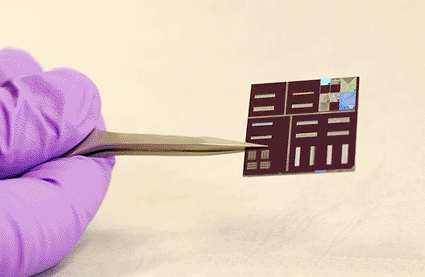
Image: Researcher holding a biochip, which functions as a collection of miniaturized test sites that allow many tests to be carried out simultaneously (Photo courtesy of BSIP, Chagnon).
The researchers, from the University of Maryland's A. James Clark School of Engineering and the University of Maryland Biotechnology Institute (UMBI; College Park, MD, USA), created the biochip as a tiny bioprocess "factory” containing multiple processing sites that are addressed fluidically, electrically, and optically. At these sites the researchers used electrical voltage to place the naturally occurring biopolymer chitosan, which serves as a platform for assembling biomolecules. They have now effectively assembled an enzyme from bacteria within the biochip and demonstrated that it can catalytically convert a small molecule, S-adenosyl-L-homocysteine
(SAH), to adenine and S-ribosylhomocysteine (SRH) products--products essential for cell-cell communication.
"We have now demonstrated perhaps the key advance needed to realize what we seek, a powerful laboratory tool for drug discovery,” said Dr. Gary Rubloff, professor in the Clark School's department of Materials Science and engineering and Institute for Systems Research (ISR), director of the Maryland NanoCenter, and a member of the research team.
The team brings together expertise in biomolecular engineering, biopolymers, chemical processing microsystems and materials. "Using biochip microfactories, we believe it will be possible to test potential drugs for their action in modifying biochemical processes that we know are important in living cells,” Dr. Rubloff said. "We hope to enable scientists and physicians to create better, more effective drugs more rapidly and at reduced cost.”
One targeted application of the microfactory is to develop drugs that can interrupt "quorum-sensing.” In quorum-sensing, a bacterium generates a small molecule called an autoinducer. The autoinducer is a signal to other bacteria, which, if present, create a quorum that is pathogenic, leading to an infection. When the pfs enzyme the researchers assembled in the biochip converted SAH to adenine and SRH, the enzyme performed the first two primary reaction steps in the production of autoinducer-2 (AI-2) by Escherichia coli bacteria, major sources of infection.
By reproducing biochemical reaction sequences such as that leading to AI-2 production, the microfactory can support drug discovery. Candidate drugs can be applied in the biochip to evaluate their ability to suppress or interrupt the production of the autoinducer as well as to identify which part of the biochemical synthesis pathway is affected by the drug.
Drugs that inhibit the action of the pfs enzyme or later steps in AI-2 synthesis will not only serve as good candidates for new antibiotics, but they promise a new approach for antibiotic therapy. Traditional antibiotics work by killing bacteria, but in doing so they trigger mutations that provide resistance to the drugs.
The University of Maryland researchers are looking for drugs that, instead of killing the bacteria, would simply interfere with the communication between them so that they do not form a coordinated pathogenic population. The team sees in the near future the use of programmable biologic microfactories as tools for rapid screening and development of new drugs prior to time-consuming, expensive clinical trials.
The study's findings were published in the March 2008 issue of the journal Lab on a Chip.
Related Links:
University of Maryland Biotechnology Institute




Platinum Member

Automated Coagulation Analyzer
Hemolumi H6
Gold Member

Neonatal Heel Incision Device
Tenderfoot

Manual Pipetting Aid
Pipette Controllers macro
New

Gastrointestinal Panel
Xpert® GI Panel