Mast Cells Point to a New Treatment Target for Asthma
By Biotechdaily staff writers
Posted on 05 Mar 2008
Posted on 05 Mar 2008
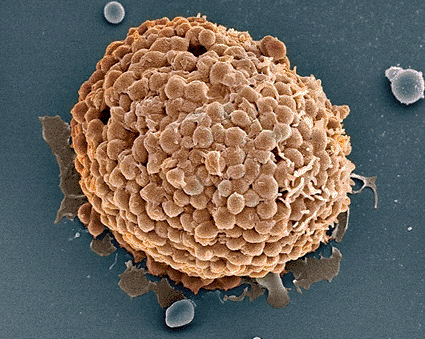
Image: Colored scanning electron micrograph (SEM) of a human mast cell (Photo courtesy of Steve Gschmeissner / SPL).
Researchers at the Weill Cornell Medical College (New York, NY, USA) examined the rings of bronchial tissue from rodents, and discovered that mast cells in these rings released renin--an enzyme which in turn produces angiotensin, a potent constrictor of the smooth muscle that lines airways--along with other substances. The researchers then attempted to confirm if the same process occurred in human tissue. Using novel technology, they confirmed for the first time that mast cells from human lung tissue release a form of renin that is nearly identical to renin found in human mast cells grown in culture or human kidney renin. The study was published in the January 29, 2008, edition of Proceedings of the U.S. National Academy of Sciences (PNAS).
"Back in 2005, our team was the first to discover that mast cells in the heart released renin locally, which elicited heart arrhythmias by triggering angiotensin production within the heart,” explained co-senior author Dr. Roberto Levi, M.D., D.Sc., a professor of pharmacology. "Now, we've expanded those findings to the lungs, where similar mechanisms appear to work locally to help trigger constriction in the airway.”
"In the heart and now the lungs, this localized production of renin appears to have a profound effect on nearby tissues,” added co-senior author Dr. Randi Silver, Ph.D., an associate professor of physiology and biophysics. "More study is needed, of course, but our finding suggests that drugs that target renin might prove effective agents in dampening asthma or other respiratory diseases. These types of 'renin inhibitors' are, in fact, currently being developed by the pharmaceutical industry right now.”
The researchers suggest that local renin production may also be crucial in diseases marked by tissue fibrosis, besides the previously shown effects of vasoconstriction and bronchoconstriction. By finding agents that dampen the renin-angiotensin cascade locally, be it in the heart or the lung, the researchers hope that a formidable new weapon against disease could be developed.
Related Links:
Weill Cornell Medical College




Platinum Member

Automated Coagulation Analyzer
Hemolumi H6
New
Gold Member

Serum Indices Control
Acusera Serum Indices Control
New

Slide Scanner System
NanoZoomer S540MD
New

Microbiology Laboratory Automation Solution
BD Kiestra™ ReadA+BarcodA