






Cholesterol-Lowering Drug an Unexpected Antibiotic
By Biotechdaily staff writers
Posted on 26 Feb 2008
Posted on 26 Feb 2008
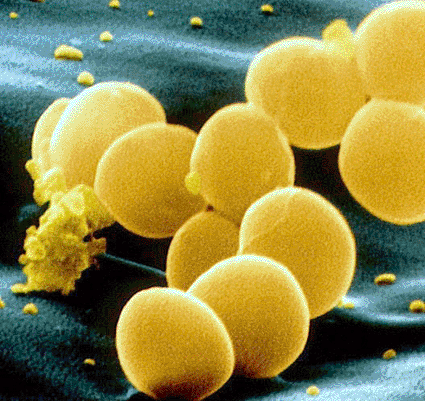
Image: Colored scanning electron micrograph (SEM) of a cluster of Staphylococcus aureus bacteria (Photo courtesy of the Eye of Science / SPL).
An international team of investigators based their attack on S. aureus on earlier findings that a strain of the bacteria lacking the golden pigment was easier to kill. Since the pathway for production of staphyloxanthin in the bacteria is similar to that for synthesis of cholesterol in humans, the investigators examined the effect of drugs that inhibit cholesterol synthesis.
They reported in the February 14, 2008, online edition of the journal Science that of eight different drug compounds tested, three blocked pigment production in S. aureus. Treatment of mice infected with S. aureus with one of the compounds reduced bacterial population by 98%.
Since stopping pigment production caused the reduction in virulence, this treatment may not cause selective pressures on the population, which often leads to antibiotic resistance. Furthermore, this method targets only S. aureus, reducing possible side effects.
"I looked at the metabolic pathway and noticed that it was similar to the one for the production of cholesterol in humans,” said Dr. Eric Oldfield, professor of chemistry at the University of Illinois (Urbana-Champaign, USA). "This is an entirely new approach that seems to work in animals, and now we need to take the next step to explore if it will work in humans.”
Related Links:
University of Illinois




Platinum Member

Automated Coagulation Analyzer
Hemolumi H6
Gold Member

NEW PRODUCT : SILICONE WASHING MACHINE TRAY COVER WITH VICOLAB SILICONE NET VICOLAB®
REGISTRED 682.9

New

Automated Immunoassay Analyzer
SuperFlex™
New

Alzheimer's Disease Biomarker Assay
Elecsys Phospho-Tau (217P) Plasma


