3D Optical Projection Tomography Images of Fruit Flies Help Advance Brain Research
By Biotechdaily staff writers
Posted on 24 Sep 2007
The brain of a fly is not an easy thing to examine, however, scientists have figured out how to make it simpler to study. Moreover, they hope their research will provide new insights into human disease.Posted on 24 Sep 2007
Utilizing an imaging technique, originally developed at the Medical Research Council (MRC) Human Genetics Unit (Edinburgh, UK), called optical projection tomography (OPT), investigators have generated amazing three-dimensional (3D) images of the inside of a fruit fly for the first time. The OPT images could help to further genetic research into Alzheimer's and other human diseases that affect brain cells.
Dr. Mary O'Connell from the MRC Human Genetics Unit, who led the research, explained, "Neurodegeneration, the gradual loss of function of brain cells that occurs in Alzheimer's, Parkinson's, and motor neuron diseases, isn't a strictly human phenomenon. Insects are affected by it too. In the autumn, bees and wasps often develop erratic behavior before they die.”
Because the fruit fly (Drosophila melanogaster) and human share many genes with similar functions, the fly is extensively used by genetic researchers to assess how genes influence human disease. "It's already known that defects in the equivalent fly genes involved in human brain diseases cause brain cells in fruit flies to lose function as they age,” Dr O'Connell continued.
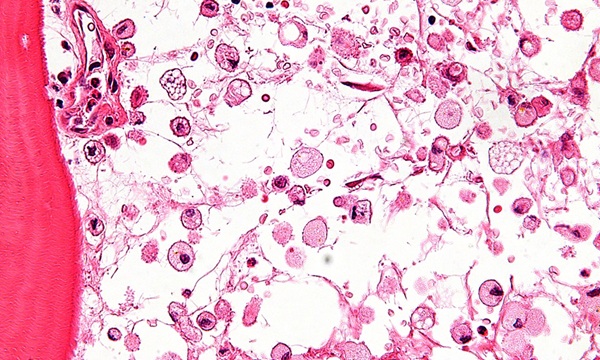
OPT could help researchers to determine how the fly brain alters in response to changes in the normal activity of a specific gene without the risk of damaging tissue through dissection. In a study published in the September 5, 2007, issue of the online, open-access journal PLoS ONE, the investigators described how they have already used the technique to image individual cavities within the brain of an aging fly and see the brain deteriorate.
MRC Ph.D. student Leeanne McGurk who captured many of the OPT images explained why the method works, "The dark color of the fly exoskeleton prevents us from seeing inside it using a standard light microscope. In the past this has meant scientists have had to tease apart fruit fly tissues by hand--a laborious process. Now, we have got over the problem by bleaching the fly exoskeleton. When the fruit fly becomes colorless it is possible to use imaging techniques not only to view its internal organs but to generate 2D and 3D images of the entire fly.”
Using OPT images in this manner will allow scientists to visualize where and how the products of selected genes are present in the fly. Dr. O'Connell concluded, "This research is not simply limited to the study of conditions like Alzheimer's but can also be used to study fly anatomy. The shape and size of organs can be affected by diseases like diabetes so imaging may yield clues to further our understanding of other conditions too.”
Related Links:
Medical Research Council




Platinum Member

Automated Coagulation Analyzer
Hemolumi H6

Gold Member

Blood-Based Protein Biomarker Solution for Alzheimer's Disease
BG-DTi2000.

All-in-One Molecular System
AIO M160


Urine Analyzer
respons® UDS100