Longboat Delivery System Could Mean More Powerful Anti-Cancer Drugs
By Biotechdaily staff writers
Posted on 17 Jul 2007
Posted on 17 Jul 2007
Image
The study was published in the July 11, 2007, issue of the Journal of the American Chemical Society. The Massachusetts Institute of Technology's (MIT; Cambridge, MA, USA) Dr. Stephen J. Lippard, Ph.D., and Stanford University's (Stanford, CA, USA) Hongjie Dai, Ph.D., and colleagues noted that efforts to produce such molecules have been stalled because the required form of platinum loses activity in the body and becomes ineffective before reaching the tumor. Their answer to this problem was to develop a carbon nanotube delivery system, eventually for delivering platinum compounds safely through the body's biochemical pathways and into the tumor. Once inside the tumor cell, the compounds convert from an inactive form into an active anti-cancer drug.
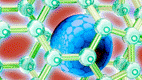
The chemistry involves attaching platinum compounds to single wall carbon nanotubes (SWNTs), one-atom thick sheets of graphite rolled up into a cylinder with a diameter about 50,000 times smaller than the width of a human hair. The SWNTs act as efficient transporters for the platinum missile, carrying it to the tumor cell and then releasing the platinum as an active drug.
In one experiment with cultured cells, the SWNTs produced platinum levels inside the cells six to eight times higher than those for the platinum unit administered in the conventional way. The longboat SWNTs have the potential to carry other compounds to and into the cancer cell, as demonstrated by the co-delivery of platinum and a fluorescent dye to the cancer cell, which in the future will include tumor-targeting components.
Related Links:
Massachusetts Institute of Technology
Stanford University




Platinum Member

Automated Coagulation Analyzer
Hemolumi H6
Gold Member

NEW PRODUCT : SILICONE WASHING MACHINE TRAY COVER WITH VICOLAB SILICONE NET VICOLAB®
REGISTRED 682.9

Immunofluorescence Analyzer
IFA System
New

Alzheimer's Disease Biomarker Assay
Elecsys Phospho-Tau (217P) Plasma