Molecular Trigger of Myelination Identified
By Biotechdaily staff writers
Posted on 09 Jul 2007
Neurologists have identified the cell adhesion molecules (CAMs) that are essential for maintaining the close contact between Schwann cells and the axon that is required for myelination in the peripheral nervous system.Posted on 09 Jul 2007
The main consequence of the myelin layer is the increase in the speed at which impulses propagate along the myelinated fiber. Along unmyelinated fibers, impulses move continuously as waves, but, in myelinated fibers, they propagate by saltation. Myelination also helps prevent the electrical current from leaving the axon. When a peripheral fiber is severed, the myelin sheath provides a track along which regrowth can occur. Unmyelinated fibers and myelinated axons of the mammalian central nervous system do not regenerate.
Demyelination, or the loss of the myelin sheath, is the hallmark of some neurodegenerative autoimmune diseases, including multiple sclerosis, transverse myelitis, chronic inflammatory demyelinating polyneuropathy, and adrenoleukodystrophy. When myelin degrades, conduction of signals along the nerve can be impaired or lost, and the nerve eventually withers.
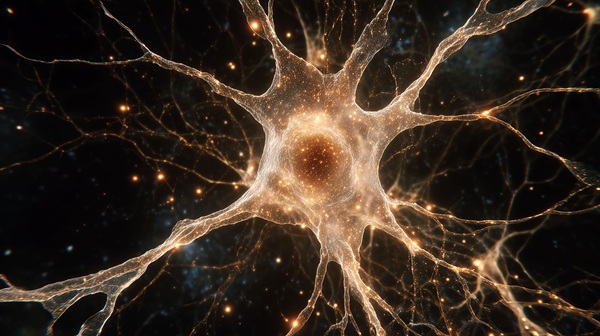
Investigators at the Weizmann Institute of Science (Rehovot, IL) reported in the July 2007 issue of Nature Neuroscience that cell adhesion molecules (CAMs) of the nectin-like (Necl, also known as SynCAM or Cadm) family mediated Schwann cell–axon interaction during myelination. They found that in the normal nervous system Necl1, which is found on the axon surface, and Necl4, which is found on the glial cell membrane, adhere tightly together. These molecules not only create physical contact between axon and glial cell, they also transfer signals to the cell interior, triggering changes needed to initiate myelination.
Production of Necl4 increased when the glial cells came into close contact with an unmyelinated axon, and as the process of myelination began. If Necl4 was absent in the glial cells, or if the attachment of Necl4 to Necl1 was blocked, the axons that were contacted by glial cells did not myelinate.
"What we have discovered is a completely new means of communication between these nervous system cells,” said senior author Dr. Elior Peles, professor of molecular cell biology at the Weizmann Institute of Science. "The drugs now used to treat MS and other degenerative diseases in which myelin is affected, can only slow the disease, but not stop or cure it. Today, we cannot reverse the nerve damage caused by these disorders. But if we can understand the mechanisms that control the process of wrapping the axons by their protective sheath, we might be able to recreate that process in patients.”
Related Links:
Weizmann Institute of Science




Platinum Member

Automated Coagulation Analyzer
Hemolumi H6

Gold Member

Aspiration System
VACUSAFE
Platinum Member
Integrated Biochemical & Immunological System
Biolumi CX Solution X10+C10

Electrolyte Analyzer
BKE-B