Buckyballs to Fight Allergies
By Biotechdaily staff writers
Posted on 05 Jul 2007
Posted on 05 Jul 2007
Image
Allergic disease is the sixth leading cause of chronic disease in the United States, and while various treatments have been developed to control allergy, no cure has been found. These findings advance the emerging field of medicine known as nanoimmunology. The researchers, from Virginia Commonwealth University (VCU; Richmond, VA, USA) and Luna Innovations, Inc. (Roanoke, VA, USA), a research company, are the first to demonstrate that buckyballs are able to block allergic response in human cell culture experiments.
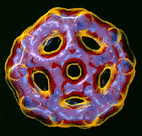
Buckyballs, or fullerenes, are molecules composed entirely of carbon. Due to their unique structure, inertness and stability, researchers from a number of scientific fields have been investigating the tiny, hollow carbon cages to serve a variety of functions. In this study, scientists modified the buckyballs so that they were compatible with water.
"This discovery is exciting because it points to the possibility that these novel materials can one day lead to new therapies,” said Chris Kepley, Ph.D., M.B.A., assistant professor in the department of internal medicine, division of rheumatology, allergy, and immunology at the VCU School of Medicine. "Researchers in many fields are aware of the potential fullerenes have, however, we are the first to show they can turn off the allergic response and basic immune reactions.”
According to Dr. Kepley, who is the lead author of the study, the buckyballs are able to ‘interrupt' the allergy/immune response by suppressing a fundamental process in the cell that leads to the release of an allergic mediator. In essence, the buckyballs are able to prevent mast cells from releasing histamine.
Mast cells are responsible for causing allergic response and are stuffed with granules containing histamine. They are present in nearly all tissues except blood. When mast cells are triggered, inflammatory substances such as histamine, heparin, and a number of cytokines are quickly released into the tissues and blood, promoting an allergic response.
The researchers discovered that the unique structure of the buckyball enables it to bind to free radicals dramatically better than any anti-oxidant currently available, such as vitamin E. Free radicals are molecules that cause oxidative stress, which scientists believe may be the basis of aging.
The immune system both protects us and causes harm, so we are always interested in finding new pathways to help manage the harmful effects, said Dr. Kepley.
The new study findings were published online in the June 19, 2007, issue of the Journal of Immunology.
Related Links:
Luna Innovations Inc.
Virginia Commonwealth University




Platinum Member

Automated Coagulation Analyzer
Hemolumi H6

Gold Member

Electrolyte Analyzer
CBS-4000 (CBS-400)

New

Microbiology Laboratory Automation Solution
BD Kiestra™ ReadA+BarcodA

New

Drug Testing Assays
Atellica DT 250 Analyzer