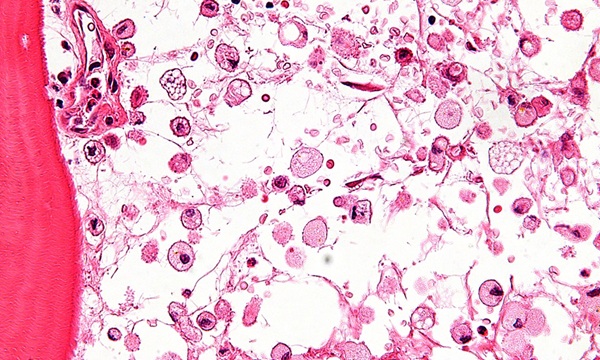
Inhibition of Transglutaminase Triggers Death of Pancreatic Cancer Cells
By Biotechdaily staff writers
Posted on 09 Apr 2007
A recent study's findings demonstrated how elevated expression of tissue transglutaminase (TG2) in cancer cells functions in the development of drug resistance and metastatic phenotypes.Posted on 09 Apr 2007
Like other transglutaminases, TG2 cross links proteins between a lysine residue and a glutamine residue in two protein chains, creating a bond that is highly resistant to proteolysis. It is particularly notable for being the autoantigen in celiac disease, but is also known to play a role in apoptosis, cellular differentiation, and matrix stabilization.
Investigators at the University of Texas M.D. Anderson Cancer Center (Houston, USA) worked with a mouse model of pancreatic cancer to determine how overexpression of TG2 protected the cancer cells from induced self-digestion (autophagy). Autophagy, like apoptosis, is a normal biologic defense mechanism that systematically destroys defective cells by forcing them to kill themselves. In apoptosis, the cells die via damage to their nucleus and DNA, with other cellular organelles preserved. Autophagy kills by degrading those other organelles while sparing the nucleus.
The initial strategy was to interfere with TG2 by inhibiting its activating protein, protein kinase C (PKC). This was done either with the drug rottlerin or by use of a small interfering RNA (siRNA). Subsequently, siRNA was used to directly inhibit TG2. Results published in the March 2007 issue of Molecular Cancer Research revealed that treated pancreatic cancer cells demonstrated a marked increase in autophagy shown by the presence of autophagic vacuoles in the cytoplasm. Furthermore, inhibition of TG2 by rottlerin or by the siRNA led to accumulation of green fluorescent protein (GFP)-LC3-II in autophagosomes in pancreatic cancer cells.
"Expression of TG2 is tightly regulated in a healthy cell,” said senior author Dr. Kapil Mehta, professor of experimental therapeutics at the University of Texas M. D. Anderson Cancer Center. "It is temporarily increased in response to certain hormones or stress factors. However, constitutive expression of this protein in a cancer cell helps confer protection from stress-induced cell death. We are developing TG2 as a pharmaceutical target and are now working with a mouse model to that end.”
Related Links:
University of Texas M. D. Anderson Cancer Center




Platinum Member

Automated Coagulation Analyzer
Hemolumi H6

Gold Member

Electrolyte Analyzer
CBS-4000 (CBS-400)
New

Slide Scanner System
NanoZoomer S540MD


Urine Analyzer
respons® UDS100