






Bone Marrow Stromal Cells May Regenerate Brain Tissue
By Biotechdaily staff writers
Posted on 31 Mar 2006
Posted on 31 Mar 2006
Image
The study was published in the March 2006 issue of the Journal of Nuclear Medicine. "Our study showed that cell transplantation therapy may improve brain receptor function in patients who suffered from cerebral stroke, improving their neurological symptoms,” said Satoshi Kuroda, M.D., Ph.D., who is with the department of neurosurgery at Hokkaido University School of Medicine (Sapporo, Japan). "How the transplanted bone marrow stromal cells restore the lost neurologic function is not clear,” added the co-author of the study.
What researchers do know is that cells found in an adult's bone marrow--stromal cells--may provide a safe, ethical source for replacing brain cells lost to neurologic disease such as Alzheimer's and Parkinson's diseases. Studies have demonstrated that cells taken from adult human bone marrow may possibly be modified into neural cell--cells with the capacity to convert to any type of cell found in the body--that could then be transplanted into the brain.
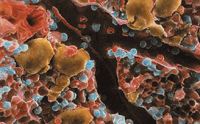
Utilizing autoradiography, a technique that uses x-ray film to visualize radioactively labeled molecules, and fluorescence immunohistochemistry, an evaluation of sections of tissue for specific proteins by binding them with certain antibodies, the researchers examined the binding of a radioactive molecule with a specific receptor protein in lab animals with cerebral infarcts or strokes. Their study "clearly showed” that bone marrow stromal cells "may contribute to neural tissue regeneration by migrating toward the peri-infarct area and acquiring the neuron-specific receptor function,” reported the article.
The authors stressed, however, that "it is essential to clarify the underlying mechanism before undertaking clinical trials with stem cell-based approaches for patients with cerebral stoke.” Their findings "may help fill in a piece of the ‘missing link' between histologic findings and functional recovery in animal studies and may be useful for further stem cell research.”
More studies need to be performed "to fully clarify the mechanism of cell transplantation therapy for neurological disorders,” said Dr. Kuroda. "When the efficacy, mechanism, and safety of cell transplantation therapy are established, we will be able to apply it to clinical situations.”
Molecular imaging and nuclear medicine are useful tools that allow the visualization of different kinds of neuronal functions to evaluate cell transplantation therapy in both experimental and clinical situations, according to Dr. Kuroda. "It is very difficult to visualize neuronal functions; therefore, we chose receptor imaging to assess the effects of cell transplantation therapy on cerebral stroke,” he explained.
Related Links:
Hokkaido University School of Medicine




Platinum Member

Automated Coagulation Analyzer
Hemolumi H6
Gold Member

Electrolyte Analyzer
CBS-4000 (CBS-400)
New

Fully Automated Urinalysis System
DxU 1800 Fully Automated Urinalysis System

Immunofluorescence Analyzer
IFA System


