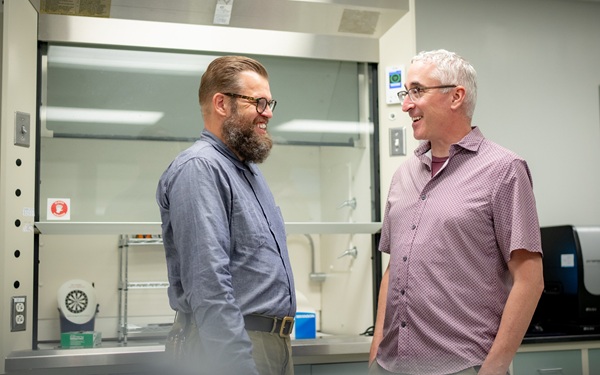
Molecular Pathway Found to Nerve Regeneration
By Biotechdaily staff writers
Posted on 14 Jul 2004
Researchers have discovered crucial processes involved in the regulation of nerve regeneration and growth that may fast-forward study in spinal cord research.Posted on 14 Jul 2004
The report, published in the June 24, 2004 issue of the journal Neuron, for the first time describes how nerve growth factor (NGF) triggers a sequence of proteins--a molecular pathway--which in turn stimulates nerve growth. "It is the first study to show the link between NGF and the building blocks that form the axon,” remarked Dr. William Snider, professor of neurology and cell and molecular physiology at the University of North Carolina (UNC, Chapel Hill, NC, USA) School of Medicine and director of the UNC Neuroscience Center.
Damage to the peripheral nervous system usually results in spontaneous regeneration and repair. However, this does not occur with the spinal cord, where disruption of connections from injury leads to paralysis. "The results of this study allow us to know more about how to promote axon growth and regeneration in the spinal cord,” said Dr. Fengquan Zhou, a coworker in Snider's lab and lead author of the study. Dr. Zhou took a unique approach in the study to locating missing pieces in the molecular pathway when he realized that NGF stimulation occurred in the growth cone of the axon. This simplified a complicated obstacle that had previously evaded others who did not focus on the growth cone.
Essentially, in the pathways Dr. Zhou identified, NGF signals the proteins P113K and GSK-3beta, and P13K, that then regulate another protein, APC, to assemble the axon from its building blocks, called microtubules. "This work helps us understand how an axon is put together and gives us a new idea about how we might make it happen after a spinal cord injury,” explained Dr. Zhou.
Related Links:
University of North Carolina




Platinum Member

Automated Coagulation Analyzer
Hemolumi H6

Gold Member

Aspiration System
VACUSAFE
New
Neurofilament Light Chain Assay
Lumipulse G NfL Blood
New

Slide Scanner System
NanoZoomer S540MD