AI-Powered 3D Scanning System Speeds Cancer Screening
Posted on 25 Feb 2026
Cytology remains a cornerstone of cancer detection, requiring specialists to examine bodily fluids and cells under a microscope. This labor-intensive process involves inspecting up to one million cells per slide to identify subtle three-dimensional changes that may signal early cancer. The manual review is time-consuming and depends heavily on expert interpretation. Researchers have now demonstrated an artificial intelligence (AI)-based 3D scanning system capable of automatically identifying abnormal cells with accuracy approaching that of human specialists, potentially transforming cancer screening workflows.
The platform called Whole-Slide Edge Tomography was developed by CYBO (Tokyo, Japan), together with a research team at The Cancer Institute Hospital of JFCR (Tokyo, Japan), and scans slides at multiple depths to reconstruct a full 3D digital model of every cell. An integrated AI program identifies individual cells and analyzes their three-dimensional shape and internal structures to classify them as healthy or abnormal. The results are organized using a method termed Cluster of Morphological Differentiation, which maps cells on a visual chart to highlight shifts from normal to diseased states.
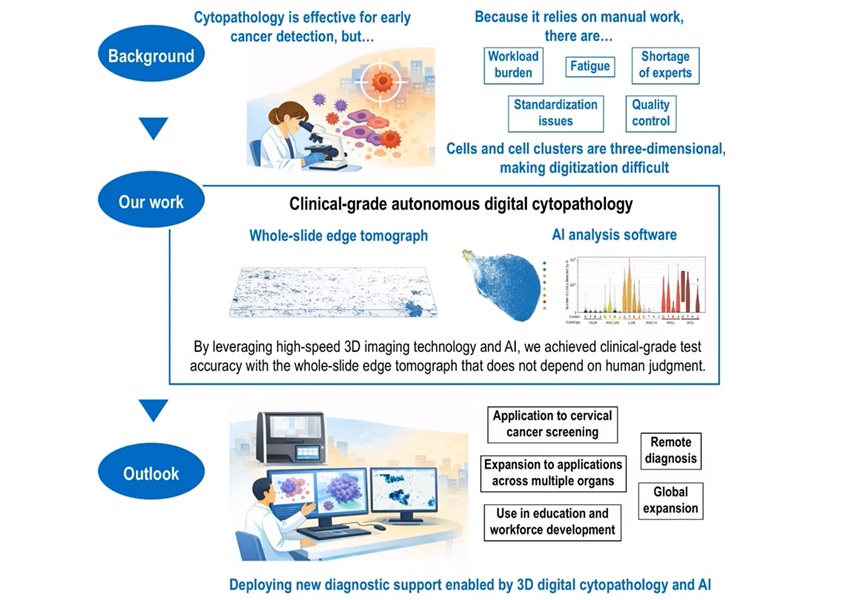
The platform was first tested on hundreds of cervical samples. The AI demonstrated a strong diagnostic performance, achieving area under the curve (AUC) values of 0.84 for early-stage abnormalities and 0.89 for more advanced disease. In a larger validation study of 1,124 slides from four medical centers, AUC values ranged from 0.86 to 0.91 for lower-grade abnormalities and reached 0.97 for high-grade lesions. The system processed entire slides in minutes and achieved near-perfect accuracy at the individual cell level, even detecting abnormal cells in samples previously classified as normal by human experts.
By providing a visual map that displays both healthy cells and those trending toward disease, the system enables clinicians to assess overall sample status at a glance rather than searching for rare abnormal cells. The rapid processing time may significantly reduce workload and improve screening efficiency. Researchers now plan to extend the platform beyond cervical cancer to evaluate its effectiveness in detecting other cancer types. If validated further, the technology could support faster, more standardized cytology-based diagnostics across multiple clinical settings.
"Our platform establishes a scalable, real-time cytology pipeline with clinical-grade autonomy and lays the foundation for an objective, reproducible and discovery-driven diagnostic paradigm," the authors wrote in their paper published in Nature.






 Analyzer.jpg)