Prostate Cancer Detected in Blood Using Flow Cytometry
By LabMedica International staff writers
Posted on 22 Feb 2016
Current methods of detecting prostate cancer, such as the prostate-specific antigen (PSA) test and biopsies, have limitations. PSA tests are based on measuring a specific protein released by the prostate gland, but do not provide a definitive diagnosis.Posted on 22 Feb 2016
A physical exam and biopsy are needed if PSA levels are elevated; however, even the painful biopsy procedure has a 15% error rate. During biopsies, a painful and invasive procedure, 12 needles are inserted into the rectum, with the hope of extracting material from an area with a tumor.
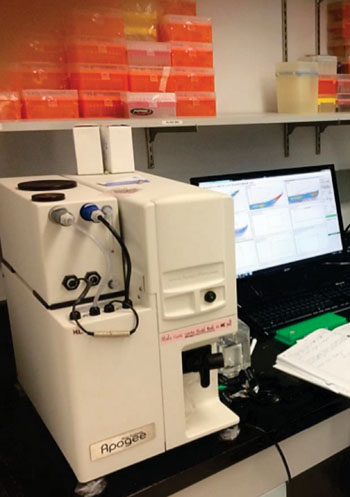
Image: The Apogee Flow Cytometer used for detecting microparticles of prostate cancer (Photo courtesy of Schulich School of Medicine and Dentistry).
A team of scientists at the Western University's Schulich School of Medicine and Dentistry (London, ON, Canada) and at Lawson Health Research Institute (London, ON, Canada) have repurposed a machine once used to detect airborne pathogens in the second Gulf War. The machine is now used for fluid biopsies, a noninvasive way to detect prostate microparticles in the blood in a matter of minutes. Microparticles are essentially refuse released by prostate cells that circulate throughout the bloodstream.
The machine was used in the Gulf War, and more commonly to test water purity and the machine uses flow cytometry (Apogee Flow Systems; Hemel Hempstead, UK) to detect microparticles. Flow cytometry measures the specific characteristics of a fluid, such as blood, as it passes through a laser. Most men, who are more than 40 years old, regardless of their health, have detectable levels of prostate microparticles in their bloodstream. The scientists have conducted the first clinical cancer project to correlate the number of microparticles in the blood to the risk of having prostate cancer in that the more microparticles, the higher the risk.
The study provides a more accurate and less invasive testing method for patients suspected of having prostate cancer, and helps to identify patients who are at a higher risk of dying from prostate cancer. Hon Leong, PhD, an assistant professor and team leader, said, “Our findings point to a new direction in how we can better identify patients who actually have prostate cancer. With this test, we can improve the clinical outcomes for patients, reducing costs for unnecessary procedures and reducing errors in diagnosis.”
Related Links:
Western University's Schulich School of Medicine and Dentistry
Lawson Health Research Institute
Apogee Flow Systems




Platinum Member

Automated Coagulation Analyzer
Hemolumi H6


MR-proADM Test
B•R•A•H•M•S MR-proADM KRYPTOR test
Gold Member

Nucleic Acid Extractor System
NEOS-96 XT