Microfluidic Device Finds Stray Cancer Cells in Blood
By LabMedica International staff writers
Posted on 07 May 2013
Cancers are often diagnosed by biopsy. A microfluidic device that captures circulating tumor cells could give doctors a noninvasive way to diagnose and track cancers in early stage.Posted on 07 May 2013
The new device combines existing microfluidic techniques of cell sorting into a single device. The result is that the tumor cells can be pulled out of a blood sample quicker, and without prior knowledge of their molecular characteristics.
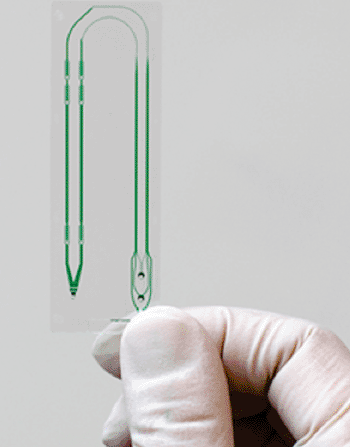
Image: A microfluidic chip captures circulating tumor cell (Photo by Berkin Cilingiroglu, courtesy of MGH).
Dr. Mehmet Toner, professor of surgery and biomedical engineering at Harvard Medical School, and the founding director of the BioMicroElectroMechanical Systems Resource Center at Massachusetts General Hospital (MGH; Boston, MA, USA) and colleagues reported that their latest chip can isolate circulating-tumor cells in the blood, and could apply to all types of cancer.
The device developed by Prof. Toner and colleagues combines magnetic labeling of cells and microfluidic sorting to process a sample of blood in about an hour or two. To capture tumor cells regardless of their cancer type, the system first tags white blood cells with magnetic beads that are covered with antibodies. The sample is then passed into microfluidic chambers that clear out red blood cells, plasma, and unused free magnetic beads based on their size. Then the device discards the tagged white blood cells using a magnetic field. “In the past, we were focused on tumor cells that we know very little about,” said Prof. Toner. “Here, we throw away the cells we know everything about, the blood cells.”
The advantage of the new cell-sorting device over previous attempts is that it successfully brings together multiple technologies, such as size separation and magnetic-tag separation, already used in the field, commented Gajus Worthington, president and CEO of Fluidigm (San Francisco, CA, USA) a company that produces microfluidic devices for biomedical research. “The key thing here is the integration, which is crucial to anything related to single-cell work,” he said. All the steps in Prof. Toner’s device take place in similar volumes. “If you have to go from one micro step back to macro step back to micro step, there are losses and complexity, which leads to noise,” he noted.
The scientists who developed this technique would like to develop it into a diagnostic procedure. The question that remains is whether early stage cancers release sufficient stray tumor cells into the blood to be detected and identified.
Related Links:
Massachusetts General Hospital
Fluidigm




Platinum Member

Automated Coagulation Analyzer
Hemolumi H6
Gold Member

NEW PRODUCT : SILICONE WASHING MACHINE TRAY COVER WITH VICOLAB SILICONE NET VICOLAB®
REGISTRED 682.9
New

Microbiology Laboratory Automation Solution
BD Kiestra™ ReadA+BarcodA
New

Slide Scanner System
NanoZoomer S540MD