Laser-Enhanced Assay Boosts Sensitivity for Colorectal Cancer Biomarker Detection
Posted on 30 Sep 2026
Colorectal cancer is the third most commonly diagnosed cancer and the second leading cause of cancer-related death worldwide. Early detection remains critical, but cancer biomarkers can produce only faint signals in blood samples, while conventional blood-based tests may require lengthy preparation and have limited sensitivity at very low concentrations. Researchers have now developed a laser-powered approach designed to enable faster detection of a colorectal cancer biomarker.
Researchers at Osaka Metropolitan University developed the approach using a microflow-type Light-induced Acceleration System (LAC-SYS) for rapid and sensitive biomarker detection. The technology is designed to detect glycoprotein CEACAM-5, a biomarker associated with colorectal cancer. The study was published in Nanoscale Horizons on June 29, 2026.
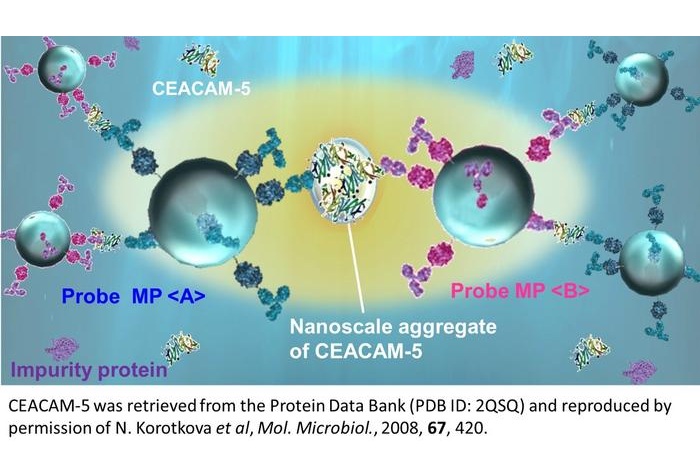
The method uses microscopic beads coated with multiple antibodies, which are introduced into a small flow channel containing blood plasma. When the sample is exposed to laser irradiation, LAC-SYS enhances interactions between the antibody-coated beads and CEACAM-5, causing the beads to assemble and produce a measurable signal.
The researchers tested the system using diluted blood plasma samples. For each experiment, 5 µL of plasma was serially diluted, with 1,000-fold diluted samples used primarily for patients with colorectal cancer. The method detected CEACAM-5 at concentrations of 1–10 picograms per milliliter in diluted plasma, representing a potential sensitivity improvement of one to two orders of magnitude compared with conventional immunoassays such as enzyme-linked immunosorbent assays and immunoprecipitation.
Further analysis showed that CEACAM-5 exists in blood as nanoscale aggregates. These clusters may interact efficiently with the antibody-coated beads, promoting bead assembly and strengthening the resulting detection signal. Based on this mechanism, the researchers said the technology could potentially be adapted to other disease-related biomarkers, including those associated with dementia and infectious diseases.
The next step is to validate the technology in clinical settings and determine how reliably it can distinguish disease-related signals in patient samples. The team also plans to work with industry partners to develop practical, portable diagnostic systems for broader use.
“Ultimately, our goal is to establish a rapid, highly sensitive, and minimally invasive platform for liquid biopsy and other blood-based diagnostic technologies that can support earlier disease detection and intervention,” said Takuya Iida, professor at the Graduate School of Science and Research Institute for LAC-SYS (RILACS) at Osaka Metropolitan University and lead author of this study.
Related Links
Osaka Metropolitan University