Study Reveals Immune Mechanism Driving Severe COVID-19 Progression
Posted on 27 Jul 2026
Severe COVID-19 has highlighted gaps in understanding of early antiviral responses, particularly why some patients deteriorate despite timely care. Type I interferons are central to host defense, yet their failure in critical illness has been difficult to explain. Clarifying this mechanism could guide risk assessment for viral infections that continue to burden health systems. New findings demonstrate how pre-existing immune factors can disable type I interferon activity in people who developed severe COVID-19.
At the University of Sharjah, investigators and international collaborators found that an affinity-matured autoimmune B‑cell response generates antibodies capable of neutralizing type I interferons. Under normal conditions, these cytokines alert neighboring cells and initiate antiviral programs; however, the study shows that in a subset of patients, the antibodies target interferon‑α and interferon‑ω and block their function. The work identifies three principal B‑cell epitopes spanning all major regions of type I interferons, explaining the breadth of neutralization.
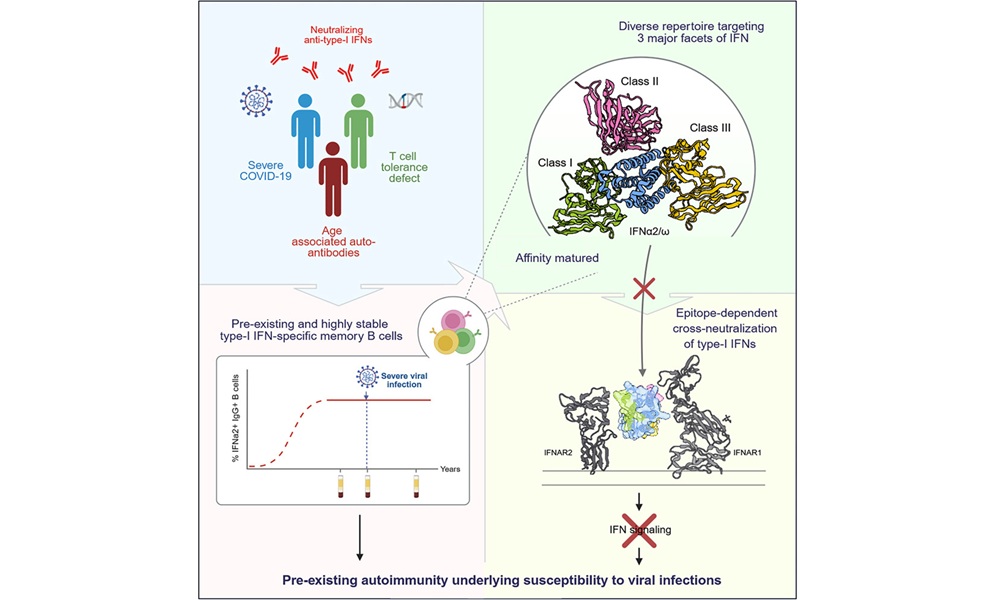
The team combined patient‑derived monoclonal antibodies with X‑ray crystallography and AlphaFold3‑based structural analyses to map antibody–interferon interactions in detail. Extensive somatic hypermutation and evidence of prolonged affinity maturation were observed, indicating a mature, organized autoimmune response rather than a transient byproduct of severe infection. Researchers examined hundreds of antibodies, revealing how this response can exist silently prior to viral exposure and then undermine innate defenses at infection onset.
According to the authors, the findings help explain why some individuals progressed to life‑threatening disease during SARS‑CoV‑2 infection and may be relevant to other respiratory viruses, including seasonal influenza. The study is global in scope, with contributors from universities and research institutes across France, Switzerland, Canada, Spain, Belgium, Saudi Arabia, Sweden, Denmark, Italy, the U.S., Estonia, and the United Arab Emirates. The work was published in Cell.
“The researchers found that these patients had a large and diverse population of B cells specifically programmed to recognize interferons,” said Rabih Halwani, professor of immunology at the University of Sharjah. “Importantly, this abnormal immune response was detectable before the patients developed life-threatening viral disease, suggesting that it was not simply a consequence of severe infection but rather a pre-existing defect that may have contributed to the patients' vulnerability.”
Related Links
University of Sharjah