RNA Blood Test May Enable Earlier Alzheimer’s Disease Diagnosis
Posted on 23 Jun 2026
Alzheimer’s disease affects an estimated 55 million people worldwide and remains difficult to diagnose at an early stage. Diagnostic workups can be complicated by symptom overlap with other conditions, while reliance on lumbar puncture or positron emission tomography (PET) may limit access to timely testing. A blood-based approach could help address these barriers by streamlining case finding and supporting longitudinal monitoring in routine care. New findings demonstrate that brain-derived RNA carried in circulating nanoparticles may enable earlier detection through a simple blood test.
Researchers at the Icahn School of Medicine at Mount Sinai (New York, NY, USA) identified brain-derived RNA biomarkers in blood and described a simple, efficient, and cost-effective method to isolate extracellular vesicles and particles (EVPs). The study, published June 22, 2026, in Nature Communications, introduces “SECmeres,” a subpopulation of small blood nanoparticles enriched with brain-specific markers. The work outlines a potential liquid-biopsy strategy for Alzheimer’s disease that the authors say could support earlier and easier diagnosis.
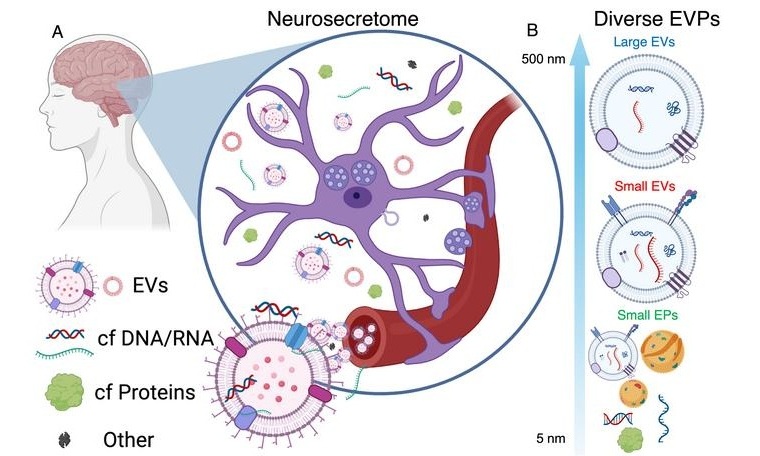
The approach builds on evidence that several brain-derived EVPs can cross the blood–brain barrier and enter circulation. Investigators isolated EVPs from blood and brain tissue and separated them into three subpopulations: large extracellular vesicles (EVs), small EVs, and small extracellular particles (EPs). They then measured RNA biomarkers to determine gene expression patterns and cellular origins relevant to Alzheimer’s disease.
Analyses of samples from individuals with Alzheimer’s disease and controls showed that a new subclass of nanoparticles, SECmeres, carried Alzheimer’s-related brain signals more clearly than standard EVs. The findings indicate that blood EVPs contain brain-specific RNA information and may offer a promising, minimally invasive path toward earlier diagnosis. Experts from Yale University and Emory University contributed to the research, which the authors note could inform development of RNA-based liquid-biopsy technologies aimed at detecting neurodegenerative disorders, cancer, and other diseases through minimally invasive testing.
“Our study demonstrates that blood EVPs carry brain-specific RNA information that could be used for liquid biopsy approaches, pending validation in larger blinded clinical trials. We believe EVP-derived RNAs may reveal disease-related changes earlier in the disease process, before proteins or pathology become detectable,” said Navneet Dogra, Ph.D., assistant professor of pathology, molecular and cell-based medicine, and member of the Icahn Genomics Institute at the Icahn School of Medicine at Mount Sinai.
“Alzheimer’s disease represents a major global health challenge due to its increasing prevalence, profound impact on patients and families, and substantial economic burden. Our findings support the development of RNA-based liquid-biopsy assays that may help advance earlier detection of Alzheimer’s disease,” said Panos Roussos, MD, Ph.D., professor of psychiatry, and genetics and genomic sciences, and director of the Center for Disease Neurogenomics at the Icahn School of Medicine at Mount Sinai.
Related Links
Icahn School of Medicine at Mount Sinai



.jpg)