Portable Rapid Test Aims to Detect Ebola at Point of Care
Posted on 24 Jul 2026
Rapid confirmation of Ebola virus disease (EVD) is essential for isolation, contact tracing, and timely care, yet many outbreak zones lack access to advanced laboratories. The current emergency in the Democratic Republic of the Congo and Uganda, caused by Bundibugyo virus (BDBV), underscores the need for robust point-of-care testing. Diagnostic tools approved for Zaire ebolavirus do not necessarily translate to BDBV, creating critical testing gaps. Researchers are now developing a portable rapid nucleic acid test to support BDBV detection at the point of care.
Osaka Metropolitan University (OMU), in collaboration with K.K. DNAFORM and the National Institute for Biomedical Research (INRB) of the Democratic Republic of the Congo, is developing the GenPad Smart BDBV portable rapid diagnostic system. The initiative was launched after the World Health Organization declared a Public Health Emergency of International Concern on May 16, 2026 for BDBV-related EVD in the region. The project has been selected for funding by the Global Health Innovative Technology Fund (GHIT Fund) and is aligned with the international “100-Day Mission” to accelerate availability of outbreak countermeasures.
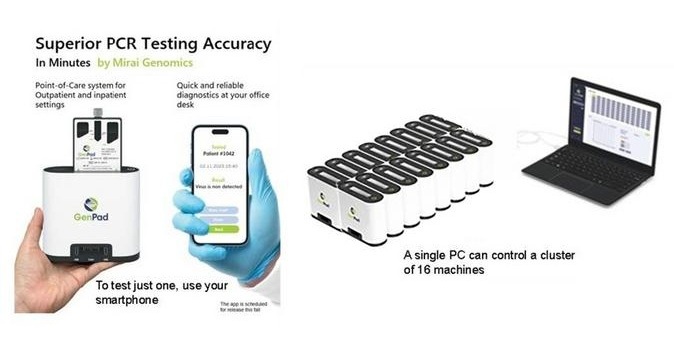
GenPad Smart BDBV is built on DNAFORM’s GenPad point-of-care testing (POCT) platform using SmartAmp isothermal polymerase chain reaction (PCR) with Eprobe detection. The platform is designed for use in settings without power infrastructure, employing portable equipment and fully sealed cartridges to simplify handling and reduce exposure risk after appropriate training. Devices can be clustered to run multiple samples simultaneously, with results available in approximately 30 minutes from blood collection.
Following the PHEIC declaration, the team produced a BDBV prototype test kit within 40 days using technology under development with support from Japan’s Acquisition, Technology & Logistics Agency. Initial laboratory evaluation confirmed the prototype met target performance criteria, including a limit of detection (LOD) of at most 200 copies per cartridge, consistent with performance criteria referenced in WHO Emergency Use Listing (EUL)-related materials. No cross-reactivity was observed against a panel of 86 microbial species. The unit is battery-powered (7.2 VDC, 21.6 Wh), weighs 460 g, and can perform eight tests on a single charge.
The development framework integrates OMU’s overseas research base and international network, DNAFORM’s portable nucleic acid testing technology, and INRB’s field investigation capacity. Since 2020, OMU and INRB have collaborated through AMED’s “Center for Translational and Effectiveness Research in Democratic Republic of the Congo,” establishing an overseas research center and joint training programs. Since 2025, OMU and DNAFORM have advanced portable POCT research through AMED support, while DNAFORM’s cartridge development system aims to enable detection of unknown pathogens within 40 days; this does not imply guaranteed performance, clinical use, or regulatory approval.
Next steps include performance validation with mock samples (armored RNA), clinical performance validation in the Democratic Republic of the Congo with INRB, and parallel development of a multiplex cartridge to differentiate BDBV, Ebola virus (EBOV, formerly Zaire ebolavirus), and SUDV, with BDBV-specific testing prioritized. The team will also prepare data required for potential WHO EUL and other emergency regulatory pathways, in close coordination with international organizations. The product remains under development and evaluation and is not intended for clinical use or commercial sale.
Related Links
Osaka Metropolitan University
DNAFORM
GHIT Fund