Biopsy-Based Gene Test Predicts Recurrence Risk in Lung Adenocarcinoma
Posted on 27 Mar 2026
Lung cancer is the leading cause of cancer death, killing more people in the United States than breast, prostate, and colon cancers combined. In lung adenocarcinoma (LUAD), tumors that invade nearby blood vessels, known as vascular invasion (VI), are more likely to recur even after surgery. Because VI is typically identified by pathologists only after resection, tailoring the operation to recurrence risk remains difficult. A new study now shows that gene expression signals in presurgical biopsies, paired with a machine learning predictor, can indicate VI and recurrence risk ahead of surgery
At Boston University Chobanian & Avedisian School of Medicine, researchers developed and validated a machine‑learning predictor that uses tumor gene‑activity measurements to detect VI in LUAD. They identified more than 400 genes whose expression differs between tumors with and without VI and confirmed these patterns in an independent cohort. The predictor provided accurate results when applied to tiny biopsy samples collected before surgery and worked well at predicting tumor recurrence in other datasets.
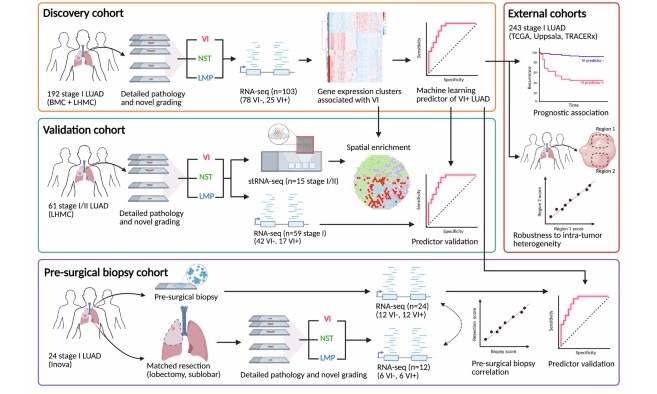
The approach derives a molecular signature of VI from gene expression profiling and classifies tumors using a trained model. Because measurements can be made on small presurgical biopsies, the method enables risk stratification prior to resection. The authors note that surgeons could perform more extensive surgery to lower recurrence risk if they could preoperatively predict which tumors are more likely to have VI.
The findings, reported in Nature Communications on March 24, 2026, focused on stage I LUAD and demonstrate that VI‑associated gene expression is detectable in presurgical biopsies. The study was conducted in collaboration with Boston Medical Center, Inova Schar Cancer Center, and Lahey Hospital & Medical Center, part of Beth Israel Lahey Health. According to the researchers, there is growing evidence that VI is linked to poor prognosis in other cancers, and further studies are needed to determine whether the same genes are altered beyond LUAD.
“We think this is a potential game changer for patients with early-stage lung cancer. Our findings suggest a simple biopsy-based test could help doctors better identify patients at higher risk of recurrence and guide treatment decisions,” said Marc Lenburg, Ph.D., professor of medicine, bioinformatics, and pathology at Boston University Chobanian & Avedisian School of Medicine.
Related Links
Boston University Chobanian & Avedisian School of Medicine