Gene Identified That Drives Aggressive Form of Breast Cancer
By LabMedica International staff writers
Posted on 13 Apr 2015
A gene has been identified that drives one of the most aggressive forms of breast cancer, giving hope that by finding a way to block the gene they may be able to make the cancer less aggressive.Posted on 13 Apr 2015
The triple-negative breast cancers are two distinct diseases that likely originate from different cell types and this helps explain why survival prospects for women with the diagnosis tend to be either very good or very bad.
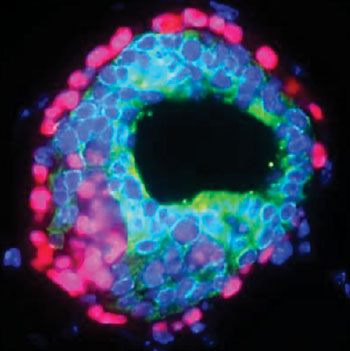
Image: Inhibitor of differentiation 4 positive (ID4+) stem cells are in red, luminal cells in green, and all cells are marked with blue nuclear dye (Photo courtesy of Garvan Institute of Medical Research).
A large multidisciplinary team of scientist led by those at the Garvan Institute of Medical Research (Sydney, Australia) found that the gene known as inhibitor of differentiation 4 (ID4) not only indicates a highly aggressive form of triple-negative breast cancer but also appears to control it. Triple negative breast cancers are breast cancers that lack estrogen, progesterone and the human epidermal growth factor receptors (HER2). Breast cancers that have these receptors can be targeted by drugs.
While the more benign form of triple-negative breast cancer appears to originate from specialized cells, the team found that the aggressive form of the disease seems to originate from stem cells. When ID4 is blocked in a stem cell, other genes that drive cell specialization are activated. In addition, the estrogen receptor and a number of other genes expressed by forms of breast cancer with better prognoses are also activated. Furthermore, ID4 is specifically expressed by a subset of human basal-like breast cancers (BLBC) that possess a very poor prognosis and a transcriptional signature similar to a mammary stem cell.
Alexander Swarbrick, PhD, the corresponding author of the study, said, “Estrogen receptor-positive breast cancers have a relatively good prognosis because the drug tamoxifen is very effective at blocking the estrogen receptor and hence their growth. We speculate, therefore, that by blocking ID4 it might be possible to turn stem-cell-like breast cancers into less aggressive breast cancers that may even respond to tamoxifen. If we are correct, that would be remarkable.” The study was published on March 27, 2015, in the journal Nature Communications.
Related Links:
Garvan Institute of Medical Research




Platinum Member

Automated Coagulation Analyzer
Hemolumi H6

New
Gold Member

Platelet Function Analyzer
PL-12


All-in-One Molecular System
AIO M160

New

Nucleic Acid Purification Instrument
QIAsymphony Connect