Novel Algorithm Improves Detection of B-ALL Gene Fusions
Posted on 15 May 2026
B-cell acute lymphoblastic leukemia (B-ALL), the most common pediatric cancer, requires accurate genomic subtyping to guide risk-stratified treatment. However, identifying fusion oncogenes can be limited by assay complexity, cost, and turnaround time. Long-read nanopore sequencing offers a more flexible approach by analyzing larger DNA and RNA fragments than short-read methods. Researchers now describe a low-coverage, low-cost sequencing strategy that increases diagnostic yield for B-ALL gene fusions.
At the University of North Carolina at Chapel Hill, investigators developed FUSILLI (FUSions In Leukemia for Long-read sequencing Investigator), a computational approach for detecting clinically relevant gene fusions in B-cell acute lymphoblastic leukemia (B-ALL). The algorithm is designed for Oxford Nanopore Technologies (ONT) long-read sequencing, which analyzes larger nucleic acid fragments and can be easier to implement across diverse resource settings than short-read platforms. Building on prior work that used nanopore RNA sequencing to classify B-ALL, the method adds sensitive detection of fusion subtypes, helping address a key gap in clinical genomic workflows.
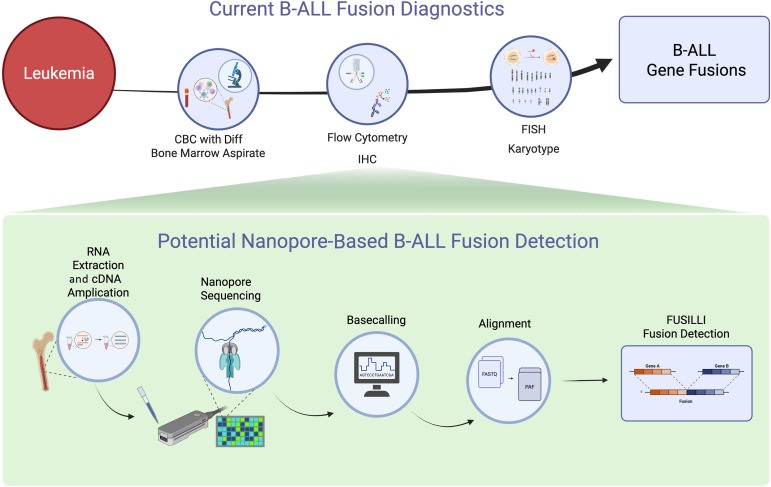
The team applied a supervised strategy to set filtering parameters that separate true fusions from technical or computational artifacts. To limit false positives from chimeric reads, fusion calls were required to be supported by at least two reads with adequate sequencing depth. A practical limit of detection of approximately 10 million reads per sample was established for reliable B-ALL fusion identification.
Using default settings in other publicly available fusion callers for comparison, FUSILLI showed higher sensitivity without a significant loss of specificity for clinically important events. By restricting analysis to clinically relevant B-ALL fusions, the search space was narrowed and computation times were faster. Beyond primary drivers, the investigators observed suggestive secondary alterations, including recurrent PAX5::ZCCHC7, with clinical relevance noted as less well characterized in this context.
The findings were published in The Journal of Molecular Diagnostics. The approach is described by the study authors as enabling higher diagnostic yield from low-coverage, lower-cost sequencing with rapid turnaround, with potential utility in resource-limited diagnostic settings.
“Long-read sequencing, and nanopore sequencing specifically, represent a new era of sequencing compared to more conventional short-read sequencing approaches. It has been around for about a decade but is now becoming mature enough for clinical applications,” said Jeremy R. Wang, Ph.D., Department of Genetics, Department of Pathology and Laboratory Medicine, and Lineberger Comprehensive Cancer Center, School of Medicine, University of North Carolina at Chapel Hill.
“With the development of FUSILLI, we show the potential of using a single low-cost sequencing assay for diagnosing gene fusion subtypes of B-ALL, with faster turnaround time. Modern genomic subtyping in pediatric B-ALL informs risk-stratification and targeted therapy, improving treatment response rate and reducing unnecessary treatment-related toxicity,” stated Dr. Wang.
Related Links
UNC Chapel Hill School of Medicine