New Liquid Biopsy Workflow Maximizes Tumor Signals from Limited Blood Samples
Posted on 17 Aug 2026
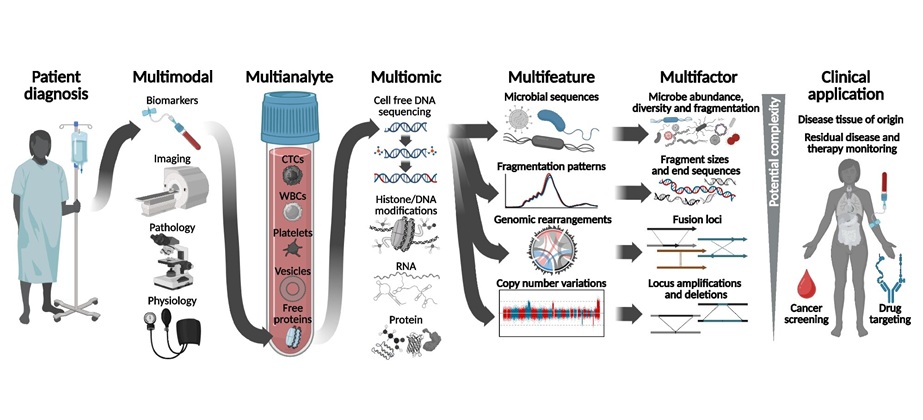
Liquid biopsy seeks to detect tumor-derived signals from small blood samples, but circulating cell-free DNA is scarce and heterogeneous, limiting sensitivity. Combining complementary signals such as methylation, fragmentomics, and mutations can improve classification and lower detection thresholds, particularly for early cancer detection and minimal residual disease. Researchers also need streamlined workflows that preserve limited samples rather than dividing them across separate assays. A new system now integrates genetic, epigenetic, and fragmentomic information from the same DNA molecules to maximize signal recovery from low-input blood draws.
biomodal (Cambridge, UK) has introduced the duet mosaic family, comprising duet +modC mosaic and duet 6-base mosaic, two circulating cell-free DNA (cfDNA)-optimized multiomic sequencing workflows for liquid biopsy and translational research. Both use a single, automation-ready process to capture genetic, epigenetic, and fragmentomic information from the same limited sample, allowing researchers to combine complementary signals without dividing material across separate assays. The workflows are designed to help researchers and assay developers maximize information recovery from small blood volumes.
The technology uses single-stranded ligation to capture multiple biological modalities from individual cfDNA molecules. Hairpin-based chemistry and associated read-resolution software reconstruct the original DNA sequence while simultaneously determining its epigenetic state. The system detects genetic variants, including C>T substitutions that can be difficult to call confidently with traditional conversion-based methylation methods, while also measuring DNA methylation and distinguishing 5-methylcytosine (5mC) from 5-hydroxymethylcytosine (5hmC). Fragmentomic features, including fragment length, end motifs, and nucleosome positioning, are preserved during library preparation and analyzed alongside these genetic and epigenetic signals.
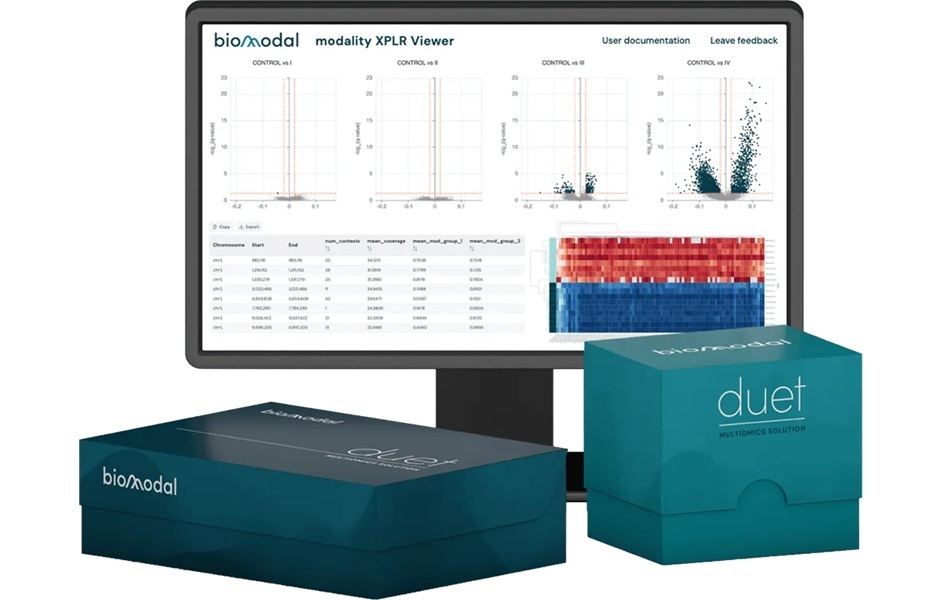
Each kit includes the duet software pipeline and modality XPLR to take users from raw reads to resolved multiomic data. Workflows run on a workstation, high-performance computing cluster, or the cloud, generate community-standard file outputs, and avoid analytics lock-in. duet +modC mosaic and duet 6-base mosaic are available now for research use in 8-, 24-, and 96-reaction formats and are compatible with standard short-read sequencing platforms.
Data presented at the European Association for Cancer Research (EACR) indicate that combining independent signals improves classification while reducing limits of detection. Applications highlighted include early cancer detection, minimal residual disease, and biomarker discovery.
“Researchers and developers are being asked to find a vanishingly small signal in a precious, limited sample, and to do it with performance they can count on. duet mosaic is built for exactly that challenge. Instead of forcing a choice between genetics, methylation or fragmentomics, we deliver all of these signals from the same molecule, in a streamlined, automation-ready workflow with software flexibility to fit how teams already work,” said Robert Osbourne, SVP Research and Development, biomodal.
“Our ongoing work in early detection of pancreatic cancer shows the need to integrate multiple different tumor markers to achieve high sensitivity, but that sometimes requires splitting a sample into multiple assays. We are investigating biomodal’s new 6-base mosaic kit to see if combining fragmentomics with 5mC and 5hmC improves our ability to detect pancreatic cancer from limited volume samples,” said Dr. Muhammed Murtaza, Director, Center for Precision Medicine, University of Wisconsin-Madison.
Related Links
biomodal