We use cookies to understand how you use our site and to improve your experience. This includes personalizing content and advertising. To learn more, click here. By continuing to use our site, you accept our use of cookies. Cookie Policy.

LabMedica

Download Mobile App
Recent News Expo Clinical Chem. Molecular Diagnostics Hematology Immunology Microbiology Pathology Technology Industry Focus

Simple Nasal Swab May Reveal Early Signs of Alzheimer’s Disease

By LabMedica International staff writers
Posted on 27 Mar 2026

Alzheimer’s disease affects millions worldwide but remains difficult to detect at its earliest, pre-symptomatic stage. Clinicians need tools that can identify biological changes before cognitive symptoms emerge, yet current blood tests often detect markers that appear later in the disease process. A new study now indicates that a quick, outpatient nasal swab could reveal early signals of Alzheimer’s disease.
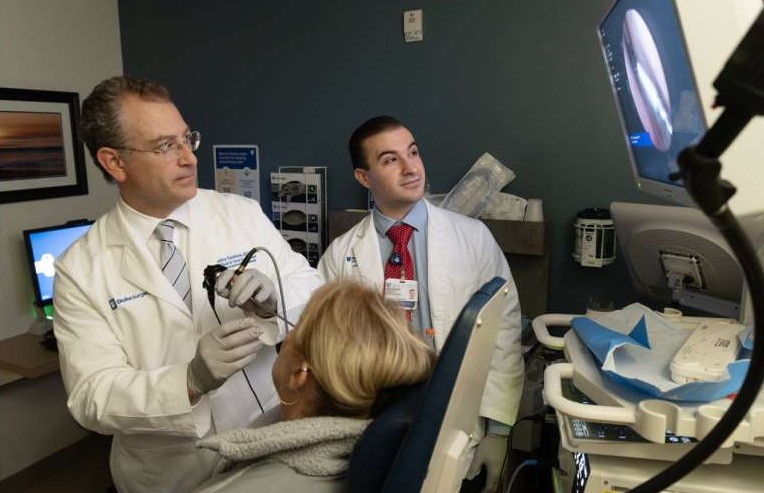

Image: Duke Health researchers Bradley J. Goldstein, M.D., Ph.D. and Vincent M. D\'Anniballe have shown a simple nasal swab can be used to detect early Alzheimer’s signals ( phot courtesy of Duke Health/ Shawn Rocco)

Researchers at Duke University School of Medicine report that a gentle, high nasal swab can collect living nerve and immune cells for molecular analysis to distinguish early or diagnosed Alzheimer’s disease (AD) from healthy controls. The work, published in Nature Communications on March 18, indicates that gene activity patterns in these cells mirror early disease biology before symptoms appear. The approach aims to characterize disease-related changes at the tissue level using a minimally invasive sampling method.

The procedure takes only minutes: after a topical anesthetic is applied, a clinician guides a tiny brush into the upper nasal cavity where smell-detecting neurons reside. Investigators then analyze which genes are active in the collected cells, generating a transcriptomic profile that reflects neural and immune states relevant to AD. Using advanced single-cell methods, the team measured activity across thousands of genes in hundreds of thousands of individual cells, yielding millions of data points.

In a comparison of samples from 22 participants, a combined nose tissue gene score correctly separated early and clinical AD from healthy controls about 81% of the time. The nasal assay detected early shifts in neuronal and immune cell populations, including in individuals with laboratory signs of AD but no symptoms. According to the authors, current blood assays detect later-arising markers, whereas this method captures real-time activity in living neural tissue.

The study involved collaboration with the Duke & UNC Alzheimer’s Disease Research Center. The researchers are expanding the work to larger cohorts and evaluating whether the swab can help monitor treatment response over time. Duke has filed a U.S. patent related to the approach.

"Much of what we know about Alzheimer's comes from autopsy tissue. Now we can study living neural tissue, opening new possibilities for diagnosis and treatment. Now we can study living neural tissue, opening new possibilities for diagnosis and treatment," said Vincent M. D'Anniballe, the study's first author and student in the Medical Scientist Training Program at Duke. 

"We want to be able to confirm Alzheimer's very early, before damage has a chance to build up in the brain. If we can diagnose people early enough, we might be able to start therapies that prevent them from ever developing clinical Alzheimer's," said Bradley J. Goldstein, M.D., Ph.D., corresponding author and professor at Duke University School of Medicine.

Related Links
Duke University School of Medicine


New
Gold Member

Automatic Hematology Analyzer
CF9600
POC Helicobacter Pylori Test Kit
Hepy Urease Test
New
Automated Phenotypic Screening Kit
MDRO Line Kits
New

Quality Control Slides
QC1 Parasitology Quality Control Slides

Latest Molecular Diagnostics News

New Respiratory Panel Expands Pathogen Detection to 25 Targets
26 Mar 2026  |   Molecular Diagnostics

Blood Biomarker Predicts Cognitive Outcomes After Cardiac Arrest
26 Mar 2026  |   Molecular Diagnostics

Liquid Biopsy Enables Faster Diagnosis of Childhood Cancer in Africa
26 Mar 2026  |   Molecular Diagnostics


INTEGRA BIOSCIENCES AG