Lung Pathogens Detected Faster by Molecular-Based Method
By LabMedica International staff writers
Posted on 07 Jul 2016
The genus Mycobacterium is separated into the pathogenic species Mycobacterium tuberculosis complex (MTB), Mycobacterium leprae, and Mycobacterium ulcerans, and various nontuberculous mycobacteria (NTM).Posted on 07 Jul 2016
New molecular-based methods are being developed to detect mycobacterial pathogens that cause pulmonary infections or tuberculosis faster than before. Time-consuming bacteria cultures no longer need to be taken from the patient samples, meaning that a suitable therapy can be started quickly.
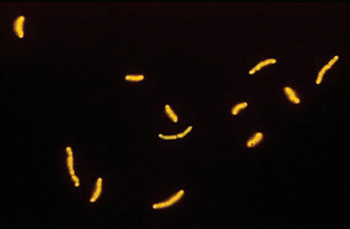
Image: A photomicrograph of auramine-rhodamine stained Mycobacterium tuberculosis (Photo courtesy of Dr. T.V. Rao, MD).
Scientists at the University of Zurich (Switzerland) used a large-scale study with more than 6,800 patient samples to examine molecular-based methods for the detection of mycobacterial pathogens. Because many mycobacteria only grow at a very slow pace, routine detection using bacteria cultures in highly specialized and expensive high-safety laboratories takes several weeks to complete. The subsequent susceptibility test to determine the appropriate medicine also takes one to two weeks.
All samples were analyzed in parallel using culture-based procedures and a modified COBAS TaqMan MTB test (Roche, Basel, Switzerland) for direct detection of MTB and NTM.MTB polymerase chain reaction (PCR) positive specimens were screened for mutations associated with resistance to isoniazid (INH) and rifampicin (RIF) using the AID TB resistance line probe assay module 1 (AID Diagnostika GmbH, Strassberg, Germany). Positive auramine-rhodamine microscopy results were confirmed by Ziehl-Neelsen staining.
MTB molecular-based detection and culture gave concordant results for 97.7% of the specimens. NTM PCR-based detection and culture gave concordant results for 97.0% of the specimens. Defining specimens on the basis of combined laboratory data as true positives or negatives with discrepant results resolved by clinical chart reviews, the scientists calculated sensitivity, specificity, positive predictive value (PPV) and negative predictive value (NPV) for PCR-based MTB detection as 84.7%, 100%, 100%, and 98.7%. The corresponding values for culture-based MTB detection were 86.3%, 100%, 100%, and 98.8%. PCR-based detection of NTM had a sensitivity of 84.7% compared to 78.0% of that of culture-based NTM detection. Molecular drug susceptibility testing (DST) by line-probe assay was found to predict phenotypic DST results in MTB with excellent accuracy.
Peter M. Keller, MD, a senior author of the study said, “For patients and doctors, this long waiting period is an unnecessary test of their patience. By comparison, with molecular detection methods, most patients know after one or two days whether they have an infection with tuberculosis pathogens or with nontuberculous mycobacteria.” The study was published on June 16, 2016, in the journal EbioMedicine.
Related Links:
University of Zurich
Roche
AID Diagnostika




Platinum Member

Automated Coagulation Analyzer
Hemolumi H6
Gold Member

Platelet Function Analyzer
PL-12

Electrolyte Analyzer
BKE-B
New
Gold Member

Serum Indices Control
Acusera Serum Indices Control