Quick Test Minimizes Unnecessary Primary Care Antibiotic Prescribing
By LabMedica International staff writers
Posted on 20 Oct 2015
C-reactive protein (CRP) is a biomarker in blood which indicates the presence of inflammation, and the amount of CRP in the body gives an indication of the severity of an infection. Low levels of CRP are indicative of viral or self-limiting bacterial infections, and high levels indicate serious infection.Posted on 20 Oct 2015
Almost 80% of antibiotics are prescribed in primary care and respiratory tract infections (RTIs) are the reason for 60% of these antibiotic prescriptions. The vast majority of these infections are self-limiting or caused by viruses in which case antibiotics have little or no clinical benefit for patients. C-reactive protein point of care testing (CRP POCT) has successfully helped to identify patients who did not require antibiotics, when presenting with symptoms of RTIs.
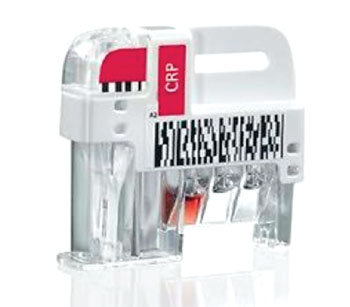
Image: The Afinion C-reactive protein (CRP) Test Cartridge contains all reagents necessary for measurement of CRP in whole blood, serum or plasma (Photo courtesy of Alere).
A study that was recently conducted that included 99 patients, aged 5 to 75 years who visited their general practitioner (GP) with a chesty cough. After undergoing a clinical scoring system, each patient's CRP levels were measured at the point of care using the Afinion CRP test, a rapid in vitro diagnostic assay for quantitative determination of CRP (Alere; Waltham, MA, USA). Only 13% of these patients needed antibiotic treatment as the CRP POCT had concluded higher CRP levels. Within one month, 17% of the 99 patients returned to the surgery and only 5% were prescribed antibiotics.
The study also provides insights on patients' expectations of receiving antibiotics. All participants had to complete a questionnaire in which they were asked whether they expected to receive antibiotics for their symptoms. Of the 26 patients expecting to receive antibiotics, only seven (27%) patients received them. Additionally, patients with lower CRP levels, who therefore would not have been suitable for antibiotics, were more likely to expect an antibiotic when asked.
CRP POCT takes less than five minutes from a finger stick blood sample to provide a quantitative result and helps to facilitate an effective conversation between patients and GPs around the rational use of antibiotics. The CRP POCT is already used in routine management in several European countries to aid diagnosis in suspected RTI and guide decision making regarding antibiotic prescribing.
Rob Cook, MD, who was involved in the study and a GP from London, said, “This study was conducted to see how feasible and useful CRP POCT is in real world general practice. We found that the test could be easily incorporated into routine care and provided very useful information for GPs and patients presenting with a cough. The vast majority of patients were reassured by a low CRP level and did not receive antibiotics.” The study was presented at the Royal College of General Practitioners (RCGP) Annual Conference held October 1-3, 2015, in Glasgow (UK).
Related Links:
Alere




Platinum Member

Automated Coagulation Analyzer
Hemolumi H6
New
Gold Member

Platelet Function Analyzer
PL-12

HPV Test
Allplex HPV28 Detection

Urine Analyzer
respons® UDS100