


New Marker Could Refine Cancer Risk Assessment in Barrett’s Esophagus
Posted on 26 Nov 2026
Barrett’s esophagus is a condition in which the normal lining of the esophagus is replaced by specialized cells resembling those found in the intestinal lining. The condition substantially increases the risk of esophageal adenocarcinoma, an aggressive cancer associated with high mortality. However, existing risk factors have limited clinical utility in identifying which patients with Barrett’s esophagus are most likely to develop cancer. To improve risk stratification, researchers have identified a potential molecular marker that could help predict cancer development at an earlier stage.
Researchers at Case Western Reserve University (Cleveland, OH, USA) identified PHGR1 as a potential protective molecular mechanism that becomes inactive as Barrett’s esophagus progresses toward esophageal cancer. Although the gene’s function remains poorly understood, the study found that its activity changes significantly during progression from Barrett’s esophagus to precancerous lesions and cancer. In noncancerous Barrett’s esophagus tissue, PHGR1 expression was elevated, potentially helping maintain important functions of the specialized cells.
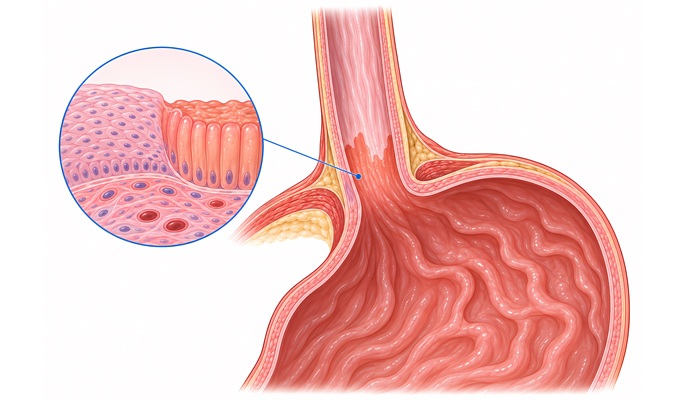
As the tissue progressed to precancerous lesions and eventually esophageal cancer, PHGR1 expression was almost completely suppressed. This loss was specifically associated with the progression from Barrett’s esophagus to precancer and cancer. Laboratory experiments showed that PHGR1 inhibited the effects of epidermal growth factor, a signaling molecule that can stimulate uncontrolled cancer cell proliferation. In mouse models, restoring PHGR1 expression significantly slowed tumor growth over time.
The researchers examined gene activity in patient tissue samples representing different stages of disease progression. The findings were published in Gastroenterology on November 23, 2026, with the research conducted by investigators from Case Western Reserve University, Case Western Reserve School of Medicine, and the Case Comprehensive Cancer Center.
The team also observed PHGR1 loss in colon cancers, suggesting that the gene may have a broader role in cancers of the digestive tract. Future research will focus on clarifying its precise molecular function and standardizing laboratory methods for measuring PHGR1 before advancing to clinical trials.
“If future studies confirm it, this could help us do three things: Identify high-risk patients earlier, detect when PHGR1 starts to disappear and develop therapies that keep this molecular brake working before cancer forms,” said Kishore Guda, professor in the Department of Pathology and GMS-Oncology at Case Western Reserve School of Medicine.
Related Links
Case Western Reserve School of Medicine