Limited Genomic Data Hinder Heart Failure Screening in Brazilian Patients
Posted on 25 Nov 2026
Heart failure is a chronic condition in which the heart cannot pump enough blood to meet the body's needs. It affects approximately 64 million people worldwide, including about 2 million in Brazil. However, genetic investigation of heart failure in Brazil is complicated by the country's genetically diverse population, which remains underrepresented in genomic databases. New findings now show how this lack of representative genetic data can reduce the accuracy of genetic screening for heart failure.
Researchers at the University of São Paulo (USP) evaluated genetic testing used to investigate the underlying causes of heart failure in Brazil. The study found that interpreting genetic test results is significantly more challenging when DNA regions are associated with African or Indigenous ancestry. Rather than reflecting limitations in sequencing technology or laboratory reagents, the difficulty stems from insufficient knowledge about the clinical significance of genetic variants identified in these populations.
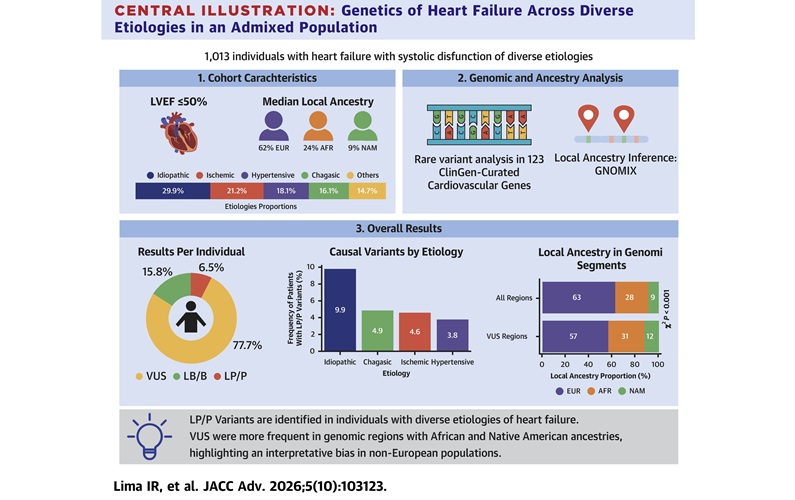
The researchers analyzed the genomes of 1,013 patients from the Heart Institute (InCor) of the Hospital das Clínicas, the hospital complex affiliated with the USP School of Medicine. Genetic variants associated with heart failure were classified according to their potential to cause disease. The analysis found that 6.5% of patients carried pathogenic variants, 15.8% had only benign variants, and 77.7% carried at least one variant of uncertain significance.
Variants of uncertain significance were more common in genomic regions associated with Indigenous or African ancestry than in those linked to European ancestry. This disparity highlights the limited availability of representative genomic reference data for these populations and the resulting challenges in accurately interpreting genetic findings. The study was published in JACC: Advances in August 2026.
The findings also underscore the clinical importance of genetic testing in heart failure, as identifying specific disease-associated variants can help inform prognosis and support more personalized treatment decisions. Detection of pathogenic variants may also guide genetic testing of first-degree relatives and, when appropriate, broader cascade screening within affected families. In Brazil, the CardioGen project, a partnership between InCor and the Brazilian Ministry of Health, supports these efforts through a national network of genetic cardiology centers providing clinical care, genetic testing, and counseling.
“What we're showing is that genetic tests are less accurate in the Brazilian population because it's been less extensively studied. It's not because the reagent or the sequencing doesn't work well. It's because we don't know what to do with the results,” said Alexandre da Costa Pereira, a researcher at InCor's Laboratory of Genetics and Molecular Cardiology.
Related Links
InCor - HCFMUSP