AI and Nanotechnology Enable Five-Minute Urine Drug Screening
Posted on 21 Nov 2026
Rapid screening for illicit drugs remains challenging when testing must be performed at the point of care. Laboratory methods provide accurate results but require sample preparation and specialized equipment, while rapid on-site test kits may be limited by insufficient sample volume and cross-reactivity with structurally similar drugs. To address these limitations, researchers have developed an artificial intelligence (AI) and nanotechnology-based platform capable of screening a single drop of urine in just five minutes.
Researchers at the Korea Research Institute of Bioscience and Biotechnology (KRIBB, Daejeon, South Korea) developed the platform to analyze raw urine without requiring chemical pretreatment. The system combines a nanostructured gold substrate with an artificial intelligence model called LightGBM, using a technique known as LightGBM-assisted surface-enhanced Raman spectroscopy (SERS) to enable interpretable screening of illicit drugs directly in urine samples.
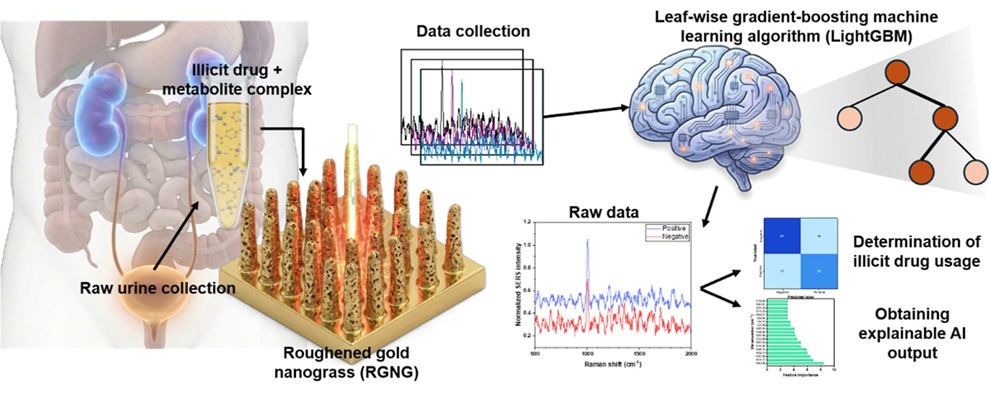
The nanostructured gold substrate amplifies weak light signals produced by drug molecules by millions of times or more, allowing even trace amounts to be detected. To achieve this, the researchers created densely packed, grasslike nanopillars on a thin gold surface and further roughened them through selective etching. When drug molecules settle on the substrate, their characteristic vibrational light signals are significantly enhanced, providing distinct spectral fingerprints that can be used for identification.
The LightGBM model analyzes these spectral fingerprints to distinguish drug-specific signals from the complex background signals found in urine. This helps overcome the challenges posed by metabolic waste products and medication metabolites that can interfere with drug detection. In tests using real urine specimens, the AI-assisted platform identified drug-positive samples with approximately 80% accuracy, including specimens from patients taking nonnarcotic analgesics or multiple medications.
In rat experiments, the researchers also showed that drug components could be analyzed in urine collected within six hours after administration. The study was conducted with Daegu Catholic University, Seoul National University Bundang Hospital, and the AI Research Center at StoneLab. The work was published in ACS Measurement Science Au in 2026.
The findings establish a core technology for rapid on-site drug screening using a single drop of urine and no sample pretreatment. The source states that, with further development into a compact portable measurement device, the platform could be used in medical and forensic settings. Potential settings identified include law enforcement drug screening and rapid assessment of drug intoxication in hospital emergency departments.
“This study demonstrates that combining nanoengineering with explainable AI algorithms can enable rapid, precise classification of illicit drugs even in complex bodily fluids. By further developing the platform into a portable diagnostic device for onsite use, we hope to transform drug screening and emergency diagnostics,” said Dr. Eun-Kyung Lim, who led the study.
Related Links
Korea Research Institute of Bioscience and Biotechnology