New Reference Material Aims to Improve Comparability of Angiotensin II Testing
Posted on 15 Sep 2026
Comparability of biomarker measurements across laboratories remains a persistent hurdle for clinical decision-making and method development. Angiotensin II, a peptide hormone central to blood pressure and fluid-electrolyte regulation and used as a vascular disease biomarker, lacks easily accessible, consistent benchmarks. The limited supply of existing international reference materials further complicates traceability and validation. To address this gap, a new study describes the development and characterization of an additional reference material intended to strengthen comparability in angiotensin II testing.
Researchers developed and characterized a candidate reference material for angiotensin II (Ang II) to provide an additional measurement benchmark. The material is intended to serve as a common standard that laboratories can use to validate analytical methods, evaluate measurement performance, and compare results across platforms. The approach addresses practical barriers to method harmonization when current international materials are difficult to access or limited in supply.
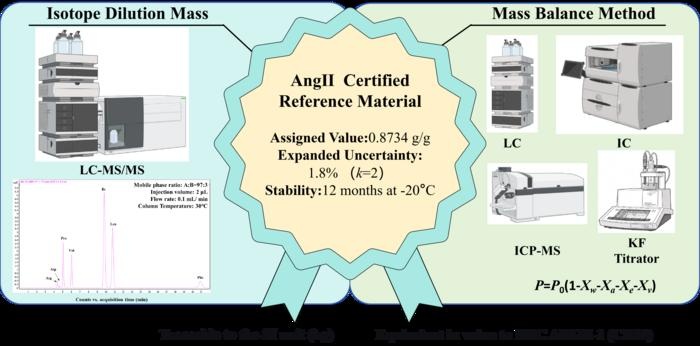
Purity assignment relied on two independent metrological strategies—isotope dilution mass spectrometry (ID‑MS) and the mass balance method—that are based on different measurement principles. Despite their distinct principles, the two approaches yielded closely consistent results, increasing confidence in the assigned value. The material demonstrated excellent bottle-to-bottle homogeneity, and the relative expanded uncertainty of the assigned value was 1.8% (k=2).
For practical deployment, stability testing showed the material remained stable for at least 12 months at −20°C. Under simulated transportation conditions, it was stable for at least seven days at both 4°C and 25°C. Measurements were also verified against NRC ANG II-1, a certified reference material from the National Research Council Canada, and the comparison met the accepted equivalence criterion, supporting the accuracy of the assigned value.
According to the study, published in Biomedical Analysis, the new reference material can support method validation, laboratory quality control, performance evaluation, and traceable measurement of Ang II, helping make results more comparable across methods and laboratories. The authors note that characterization focused on metrological properties rather than biological activity. Its biological activity has not yet been examined, and further studies will be needed to determine whether it retains equivalent activity in vivo. Within this scope, the material provides an additional tool to strengthen standardization and traceability in Ang II testing.