New Genetic Findings Reveal Cause of Bone Marrow Failure Syndrome
Posted on 10 Aug 2026
Inherited bone marrow failure syndromes (IBMFS) impair the bone marrow’s ability to produce sufficient healthy blood cells and are associated with an increased risk of early-onset myelodysplastic syndromes (MDS). In many young patients, however, the underlying germline genetic cause and disease mechanisms remain unknown, complicating diagnosis and clinical evaluation. Atelis syndrome, a neurodevelopmental disorder often accompanied by blood abnormalities, has suggested a possible overlap with bone marrow failure. New findings show that germline variants in SLF2 and SMC5 define a previously unrecognized IBMFS and predispose affected individuals to MDS.
Kyoto University researchers investigated patients with Atelis syndrome after identifying early-onset MDS and clinical features consistent with IBMFS. To explore the underlying mechanism, the team established patient-derived induced pluripotent stem cell (iPSC) lines carrying pathogenic SLF2 variants and used CRISPR-Cas9 gene editing to generate genetically corrected isogenic lines. The cells were then differentiated into hematopoietic progenitor cells to evaluate hematopoietic stem cell (HSC) function both in vitro and in vivo.
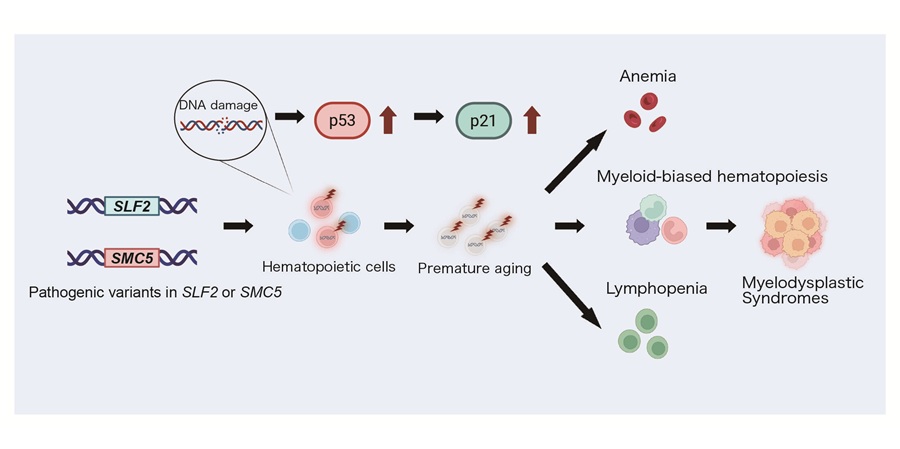
The study confirmed that germline mutations in SLF2 and SMC5 can cause IBMFS and increase susceptibility to MDS. These variants activated the tumor-suppressor protein p53 and accelerated premature aging of HSCs, providing a mechanistic link between the genetic defects, impaired blood-cell production, and increased leukemic risk. The findings are published in Leukemia on August 7, 2026.
According to the authors, the results establish SLF2 and SMC5 as causative genes for IBMFS with germline predisposition to MDS and clarify how defects in these genes contribute to premature HSC aging. The findings may also help uncover the genetic basis of unexplained bone marrow failure and early-onset MDS in young patients.
“We were intrigued to find that genes originally linked to a neurodevelopmental disorder also play a critical role in maintaining hematopoietic stem cell function and that their disruption predisposes individuals to MDS,” said Sho Shibata, first author.
“It is particularly exciting to see that correcting the SLF2 variants in patient-derived iPSCs reversed the cellular abnormalities, providing direct evidence that these variants cause bone marrow failure. We hope these findings will improve our understanding of previously unexplained cases and pave the way for new therapeutic strategies,” said Kazuhisa Chonabayashi, corresponding author.
Related Links
Kyoto University