Gut Microbiome Signatures Help Identify Risk of IBD Progression
Posted on 29 May 2026
Inflammatory bowel disease (IBD), encompassing Crohn’s disease and ulcerative colitis, is a chronic relapsing inflammatory disorder of the gastrointestinal tract with highly variable outcomes. Clinicians continue to face difficulty predicting which patients will progress to more severe disease and identifying those at highest risk early in care. Standard diagnostic categories often fail to capture the biological heterogeneity driving individual trajectories. A new study shows that distinct gut microbiome cluster types are associated with IBD severity and risk of progression.
New findings published in Microbiome Research Reports show that the gut microbiome of patients with IBD can be grouped into discrete compositional “cluster types” linked to disease severity and progression risk. These clusters represent higher-order patterns in the microbial community, rather than fluctuations in single bacterial species. The approach emphasizes community-level organization as a potential source of clinically relevant signals.
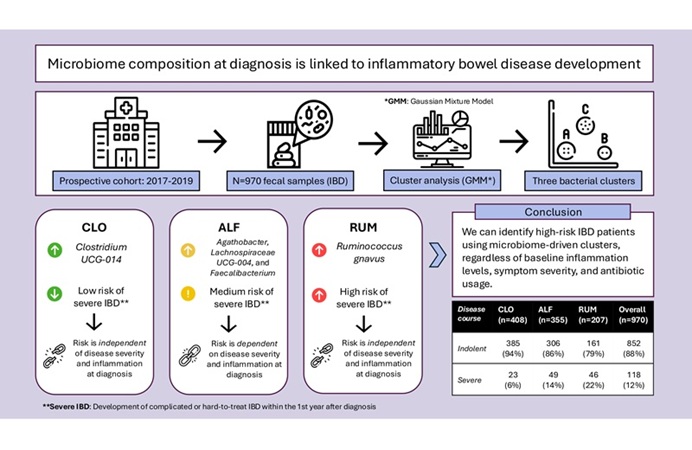
According to the authors, the results support viewing the gut microbiome as an interconnected ecological network in which disease-associated features arise from the structure of the whole community. Notably, the identified cluster types were independent of conventional diagnostic categories, including Crohn’s disease and ulcerative colitis. This independence suggests that microbiome-based stratification may capture biologically meaningful variation not reflected by current clinical labels.
The work is characterized as an experimental study. The authors indicate that this network-based perspective offers a more integrated understanding of host–microbe interactions in IBD and may help explain variability in disease progression among patients with similar diagnoses. Community-level microbiome signatures, rather than single-taxonomic markers, are proposed as the key units for risk classification.
The article, “Bacterial clusters are associated with the risk of severe disease progression in inflammatory bowel disease irrespective of conventional disease categories,” was published in Microbiome Research Reports on March 18, 2026. While larger-cohort validation is still required, the authors state that the observed patterns could contribute to improved patient stratification and more personalized IBD management.