Nanopore Method Captures RNA Folding at Single-Molecule Resolution
Posted on 19 May 2026
RNA structure plays a central role in controlling gene expression, yet its dynamic, shape-shifting behavior makes it difficult to study at single-molecule resolution. Conventional assays often average signals across many transcripts, obscuring structural heterogeneity that can affect translation and RNA stability. Full-length molecule analysis is especially valuable for clarifying these structure–function relationships in infection and other diseases. Researchers have now developed an approach that interrogates individual RNA molecules to reveal how RNA structure influences health and disease.
Scientists at A*STAR Genome Institute of Singapore (A*STAR GIS) have developed sm-PORE-cupine, a method designed to profile the folding of individual RNA molecules across diverse transcriptomes. By reading full-length RNA one molecule at a time, the approach resolves how structural variation shapes gene regulation. The team positions the method as a way to examine how RNA conformations relate to protein production and RNA turnover in cellular systems.
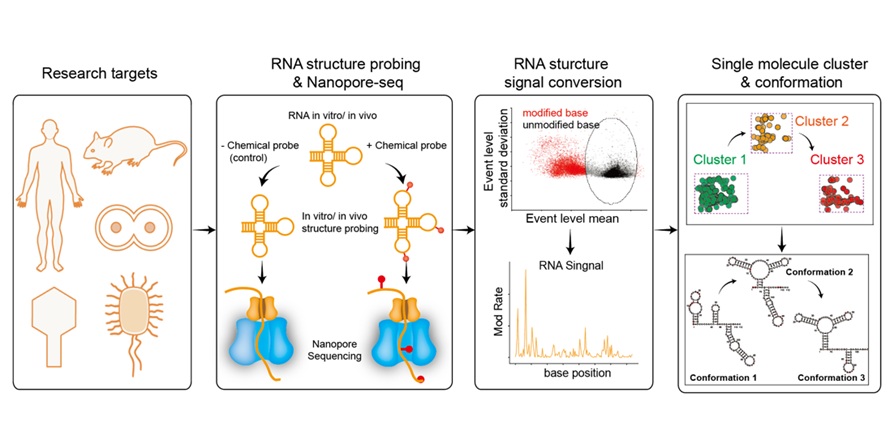
sm-PORE-cupine combines chemical labeling with nanopore direct RNA sequencing to detect structural features on single molecules. The technology uses optimized chemical compounds to mark non-paired RNA bases, which are more exposed within the molecule. These marks act like signposts, providing clues about how the RNA is folded. Nanopore direct RNA sequencing then reads the full-length RNA molecules, while computational analysis interprets the modification patterns at single-molecule resolution, revealing distinct conformations even among RNAs transcribed from the same gene.
Using this strategy, the researchers observed that structural differences among RNA molecules are linked to how efficiently proteins are synthesized and how quickly RNAs are degraded. The study also provides insights into how RNA structures influence viral function, including in viruses such as SARS‑CoV‑2, and into gene regulation in pathogenic organisms.
According to the authors, the findings could help identify RNA‑based therapeutic targets and support the development of antiviral drugs, antifungal treatments, and RNA‑targeted therapies. In the longer term, the technology and resulting knowledge could contribute to improved disease diagnostics, drug discovery, and precision medicine. The work was recently published in Nature Methods.
“At A*STAR GIS, we pursue deep scientific understanding to enable better solutions for health and disease. By uncovering how RNA molecules adopt different structures and how these structures influence gene regulation, this work lays the foundation for more precise approaches to diagnosis and treatment,” said Dr. Wan Yue, Executive Director at A*STAR GIS and lead author.
“By leveraging direct RNA sequencing using nanopores, we now have a unique capability to study the dynamics of how RNAs shape-shift. This work builds on A*STAR GIS’ significant strengths in nanopore sequencing-based analytics,” said Dr. Niranjan Nagarajan, Associate Director, AI and Compute, and Senior Group Leader, Laboratory of Metagenomic Technologies and Microbial Systems, A*STAR GIS.
Related Links
A*STAR GIS