Researchers Map Protein and Glycosylation Across 15 Human Body Fluids
Posted on 13 May 2026
Proteins circulating in human body fluids carry valuable signals for health assessment and disease detection. Many of these proteins are modified by complex glycans, a form of glycosylation that can fine-tune biological function and reflect disease-related changes, including cancer and autoimmune disorders. Although blood and urine are routinely tested, comparable molecular maps across a wider range of clinical fluids have remained limited. Researchers now present a standardized atlas profiling proteins and glycosylation patterns across 15 human body fluids.
A team led by Dr. Yong Zhang at West China Hospital, Sichuan University (Chengdu, China), has created the GlycoHBF, an atlas of proteins and glycosylation spanning 15 human body fluids. The team implemented a uniform, standardized workflow from collection and preparation through analysis to ensure comparability across matrices. The atlas encompasses plasma, urine, cerebrospinal fluid, saliva, tears, sweat, bile, synovial fluid, and other clinically relevant fluids.
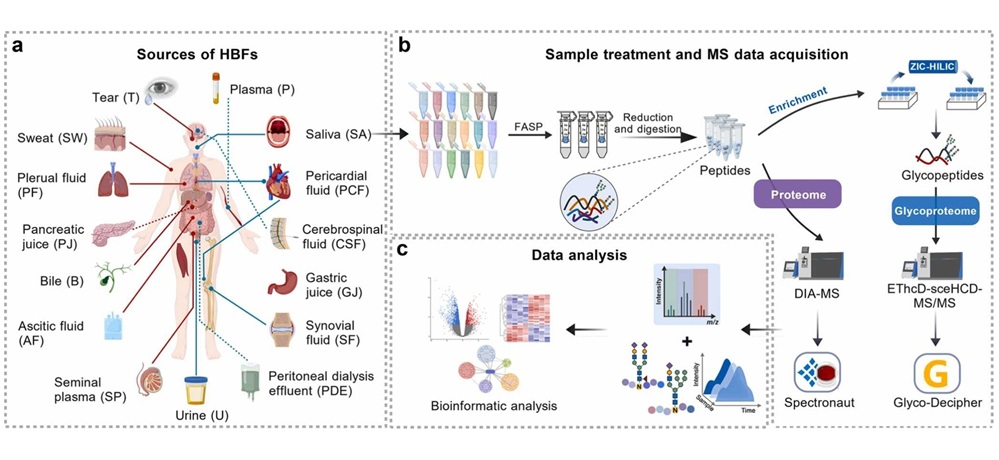
Using liquid chromatography–tandem mass spectrometry (LC-MS/MS), investigators profiled proteins and intact N-glycopeptides from each fluid. For proteins, the study employed DIA mass spectrometry, while glycopeptide characterization applied a combined EThcD-sceHCD fragmentation method. This dual-layer proteomic and glycoproteomic approach enabled direct, parallel assessment of protein abundance and glycosylation features across all fluid types. According to the authors, GlycoHBF is the first resource to enable direct, parallel comparison of proteomic and N-glycoproteomic profiles across 15 fluids using a single standardized protocol.
Across the dataset, the team identified and quantified thousands of proteins and N-glycopeptides, showing that each fluid exhibits a distinct molecular signature. Variations in glycosylation were even more pronounced than differences in protein levels alone, suggesting an additional layer of specificity that may be sensitive to local tissue environments. The standardized protocol achieved high depth and reproducibility, supporting robust cross-fluid comparisons.
The dataset is publicly available via iProX under accession PXD068799. The article, titled “GlycoHBF: Mass spectrometry-based glycoproteomics data from 15 types of human body fluids,” is published in Glycoscience & Therapy.
The study states that establishing baseline molecular profiles across healthy and non-malignant fluids can support liquid biopsy research by helping distinguish normal physiological variation from disease-associated changes. The standardized methods can be adopted to facilitate consistent, comparable analyses across large patient cohorts. The atlas is positioned to accelerate discovery of fluid-specific protein or glycopeptide signatures with potential relevance to disorders affecting the brain (via cerebrospinal fluid), lungs (via pleural fluid), kidneys (via urine), or joints (via synovial fluid).