Microfluidic Chip Detects Cancer Recurrence from Immune Response Signals
Posted on 24 Mar 2026
Early identification of treatment response and relapse remains a major challenge in solid tumors, where minimal residual disease is difficult to detect with routine imaging and blood tests. Inflammation-driven changes in leukocyte behavior can offer a functional window into tumor activity but are rarely measured directly. Centering on this host immune response, researchers have now introduced a diagnostic chip that analyzes leukocyte adhesion to detect cancer recurrence and assess chemotherapy effectiveness.
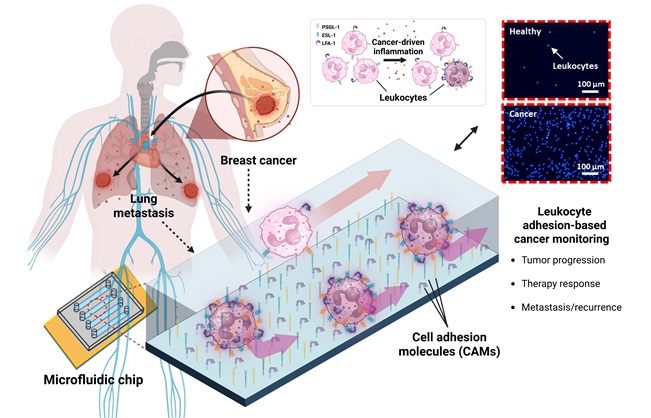
Researchers at Ulsan National Institute of Science and Technology (UNIST; Ulsan, Korea) developed a microfluidic chip that profiles leukocyte adhesion to microchannels coated with cell adhesion molecules (CAM) under physiological flow. The system operates by passing a small volume of whole blood through ultra-thin channels that are coated with proteins mimicking vascular endothelium. Leukocytes with upregulated CAM ligands—induced by tumor-associated inflammation—bind to these surfaces and are counted automatically. By quantifying the magnitude of adhesion, the system reflects the host inflammatory response related to cancer progression and treatment effects.
In preclinical testing using the 4T1 breast cancer mouse model, leukocytes from tumor-bearing animals exhibited up to a 40-fold increase in adhesion compared with healthy controls. Adhesion measurements distinguished experimental conditions corresponding to primary tumor growth, chemotherapeutic response, and postsurgical recurrence or metastasis. Following doxorubicin administration, leukocyte adhesion levels immediately decreased, whereas ineffective therapy maintained or increased adhesion, indicating ongoing tumor activity.
The platform also detected early signals of metastatic spread after primary tumor resection, with adhesion decreasing post-surgery and then rising during early metastatic phases. According to UNIST, the minimally invasive workflow provides a real-time view of the host inflammatory response and may complement liquid biopsy by capturing functional immune-tumor interactions. The findings were published in Biosensors and Bioelectronics on March 1, 2026.
“This approach enables clinicians to detect early relapse and monitor treatment efficacy by analyzing the immune response—specifically, leukocyte adhesion—rather than relying solely on imaging or invasive biopsies. It opens the door to more personalized, timely interventions, reducing unnecessary treatments and improving patient outcomes,” said Joo Hun Kang, Professor in the Department of Biomedical Engineering at UNIST.
Related Links
UNIST