Cancer-Associated Mutations Found in Patients with Unexplained Cytopenias
By LabMedica International staff writers
Posted on 17 Nov 2015
Patients with unexplained low blood counts and abnormally mutated cells who do not fit the diagnostic criteria for recognized blood cancers should be described as having clonal cytopenias of undetermined significance (CCUS).Posted on 17 Nov 2015
Myelodysplastic syndromes (MDS) are clonal bone mar row disorders characterized by inefficient and dysmorphic hematopoietic differentiation, cytopenias of the peripheral blood, and increased risk of transformation to acute myeloid leukemia (AML).
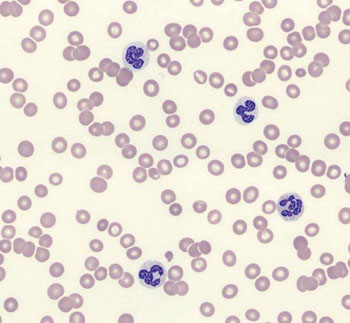
Image: Blood film from a patient with idiopathic cytopenia of undetermined significance, showing abnormal cells (Photo courtesy of University of California, San Diego Health Sciences).
Scientists at the Moores Cancer Center, (La Jolla, CA, USA) and their colleagues performed a prospective study to examine the frequency and types of mutations encountered in 144 patients with unexplained cytopenias. Patients had a complete medical history as well as screening tests that included a complete blood count with differential, iron studies, reticulocyte count, erythropoietin level, vitamin B12, and folate levels.
Genomic DNA was extracted from the bone marrow aspirate samples and selected exons and flanking sequences of 22 myeloid genes were amplified by multiplex polymerase chain reaction (PCR). Libraries were created using a Fluidigm Access Array system (Fluidigm Corporation; South San Francisco, CA, USA). Amplicon libraries were split to be sequenced on the Illumina MiSeq platform (Illumina; San Diego, CA, USA) in duplicate. For all cases, assignment to the diagnostic group was performed centrally at Genoptix Medical Laboratory (Carlsbad, CA, USA).
Based on bone marrow findings, 17% of the enrollees were diagnosed with MDS, 15% with idiopathic cytopenias of undetermined significance (ICUS) and some evidence of dysplasia, and 69% with ICUS and no dysplasia. Bone marrow DNA was sequenced for mutations in 22 frequently mutated myeloid malignancy genes. Somatic mutations were identified in 71% of MDS patients, 62% of patients with ICUS and some dysplasia, and 20% of ICUS patients and no dysplasia. In total, 35% of ICUS patients carried a somatic mutation or chromosomal abnormality indicative of clonal hematopoiesis.
Rafael Bejar, MD, PhD, assistant professor of medicine and senior author of the study, said, “We don't know to what extent patients who have low blood counts and mutations are at increased risk of developing an overt malignancy. We hope that by defining CCUS, future studies will follow these patients to learn what these mutations mean for their future as their genetically abnormal cells may represent early stages of subsequent blood cancers.” The authors concluded that CCUS is a more frequent diagnosis than MDS in cytopenic patients. The study was published on October 1, 2015, in the journal Blood.
Related Links:
Moores Cancer Center
Fluidigm Corporation
Illumina




Platinum Member

Automated Coagulation Analyzer
Hemolumi H6


New

Drug Testing Assays
Atellica DT 250 Analyzer
Gold Member

Fully-auto Specific Protein (Nephelometry) Analyzer
PA240