Experimental Blood Test Detects Markers of Three Cancers and Alzheimer’s Disease
Posted on 20 Nov 2026
Colorectal cancer, glioblastoma, pancreatic cancer, and Alzheimer’s disease are serious conditions in which earlier detection may improve clinical outcomes. Blood-based testing could help identify disease-associated signals from small sample volumes, but exosome detection can be complicated by interference from other molecules in the blood. To overcome this limitation, researchers have developed an experimental diagnostic platform that screens for all four diseases using 10 microliters of blood in about one hour.
Researchers at the University of Notre Dame developed the patent-pending diagnostic platform using immunojanus particles, tiny spheres with two chemically distinct halves. One side is coated with antibodies that bind disease-associated targets, while the other is fluorescent and provides a detectable signal. The platform is designed to identify exosomes in blood that carry proteins associated with disease.
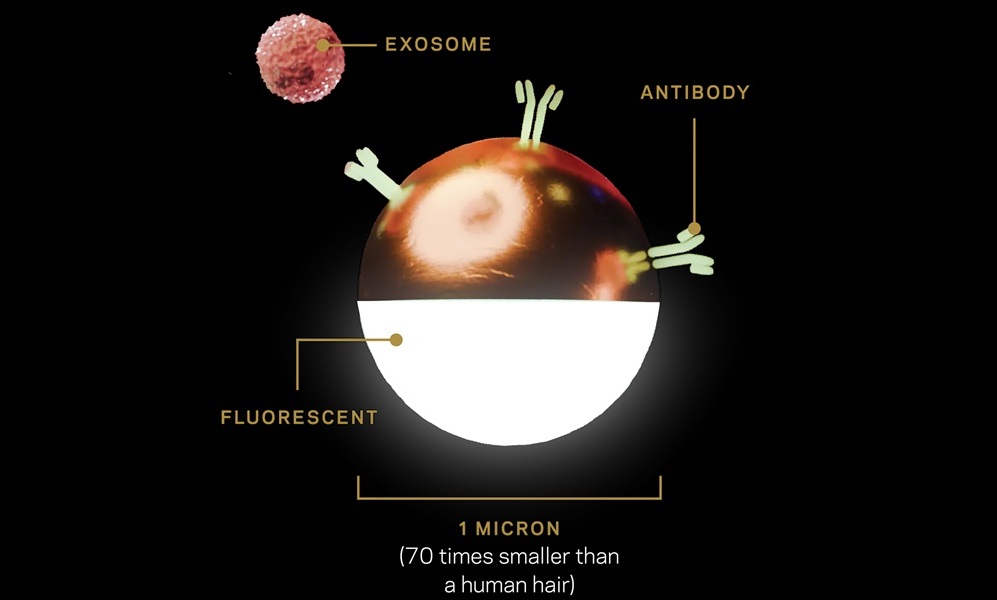
To perform the test, blood is diluted with saline and mixed with the immunojanus particles for 10 to 60 minutes. As the particles disperse through the sample, their antibodies bind to disease-specific proteins on the surface of exosomes. The sample is then examined under a microscope, where proprietary software analyzes the particles’ Brownian motion to determine whether a disease-associated marker is present.
The platform was evaluated in a blind setting using 87 plasma samples from blood draws from healthy individuals and patients with one of the four diseases. It showed 90% to 99% accuracy for detecting the presence or absence of each disease type. The study, “Rapid and sensitive detection of cancer-derived small extracellular vesicles using Janus particles,” was published in Nature Biomedical Engineering
The method is described as fast and low-cost, and as more accurate than the leading exosome detection technology. Its design addresses interference by combining sensitivity to single exosome binding with selectivity against other small molecules. “We believe that if we can screen these diseases earlier, then patients may have a better chance at surviving,” said Hsueh-Chia Chang, the Bayer Corporation professor of engineering in the Department of Chemical and Biomolecular Engineering at Notre Dame.
“We had to overcome the interference issue, and immunojanus particles can because they are both sensitive and selective. Sensitive because we can detect a single exosome on an immunojanus particle from the blinking frequency, and selective because other small molecules do not produce a signal,” added Chang.
Related Links
University of Notre Dame







.jpg)