Blood-Detected Chromosomal Changes May Refine Colorectal Cancer Risk Assessment
Posted on 11 Nov 2026
Colorectal cancer is among the most common cancers worldwide and a leading cause of cancer-related mortality. Identifying individuals at increased risk could help guide more targeted screening and prevention strategies. However, existing approaches based on inherited genetic risk and lifestyle factors may not fully capture cumulative biological risk. New findings suggest that mosaic chromosomal alterations detected in blood could provide additional insights to improve colorectal cancer risk stratification.
Researchers at Wuhan University (Wuhan, China) and collaborating hospitals conducted a large multicenter case-control study to evaluate the association between mosaic chromosomal alterations (mCAs) and colorectal cancer risk. These large-scale somatic chromosomal changes arise after conception and can be detected in blood-derived DNA. They include chromosomal gains, losses, and copy-neutral loss of heterozygosity (CN-LOH), and may accumulate with age or be influenced by lifestyle and environmental factors.
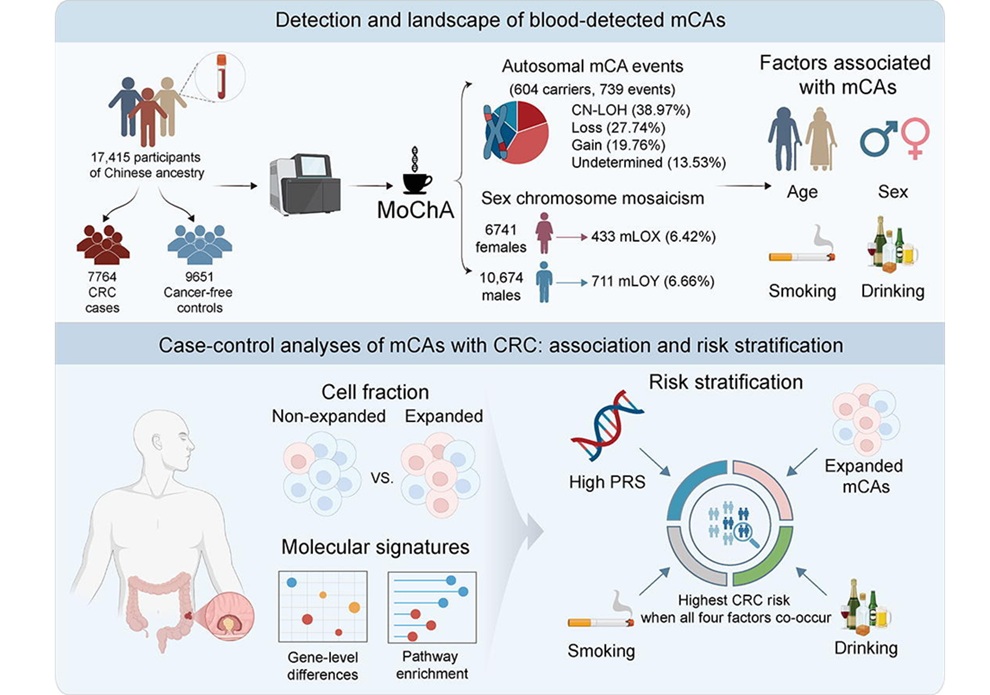
The study included 17,415 Chinese participants, comprising 7,764 colorectal cancer cases and 9,651 cancer-free controls. Autosomal mCAs were detected in 604 participants (3.47%), while mosaic loss of chromosome X was identified in 433 of 6,741 women and mosaic loss of chromosome Y in 711 of 10,674 men. Overall genomic patterns were broadly consistent with findings from the UK Biobank and BioBank Japan, although some population-specific differences emerged.
The likelihood of carrying mCAs increased with age and was also associated with smoking and alcohol consumption. Participants carrying any autosomal mCA had 22% higher odds of colorectal cancer. CN-LOH, mosaic loss of chromosome X, and mosaic loss of chromosome Y were also associated with increased colorectal cancer risk, with generally stronger associations observed for expanded mCAs.
Researchers then examined whether mCAs could provide additional risk information beyond inherited genetic susceptibility and lifestyle factors. Expanded mCAs identified higher-risk subgroups across polygenic risk categories, particularly among individuals with high genetic susceptibility. When polygenic risk was combined with smoking and drinking status into three risk categories, expanded mCAs further distinguished colorectal cancer risk within these groups.
The strongest associations were observed among participants with high combined genetic and lifestyle risk who also carried expanded mCAs. Compared with individuals in the lowest combined-risk group without the corresponding alteration, odds ratios reached 6.53 for expanded CN-LOH, 6.89 for expanded mosaic loss of chromosome X, and 3.12 for expanded mosaic loss of chromosome Y. These findings suggest that blood-detected mCAs could complement genetic and lifestyle information to improve colorectal cancer risk stratification.
Related Links:
Wuhan University