


Portable Test Detects Zika and Hepatitis C RNA from Whole Blood
Posted on 11 Nov 2026
Timely detection of Zika virus and hepatitis C is essential, but conventional testing often relies on centralized laboratories and complex sample processing. In regions with limited medical infrastructure, specimen transport and purification requirements can delay diagnosis, while RNA degradation may compromise molecular detection. Researchers have now developed a portable protocol that enables direct detection of viral RNA from whole blood without conventional laboratory equipment.
Researchers at the Grainger College of Engineering at the University of Illinois Urbana-Champaign developed a point-of-care protocol for detecting Zika virus and hepatitis C viral RNA directly from whole blood. The method uses heat to dry blood samples before amplifying the preserved viral RNA and detecting it through fluorescence. Requiring only a portable heater and handheld fluorescence reader, the workflow can be completed on site within hours.
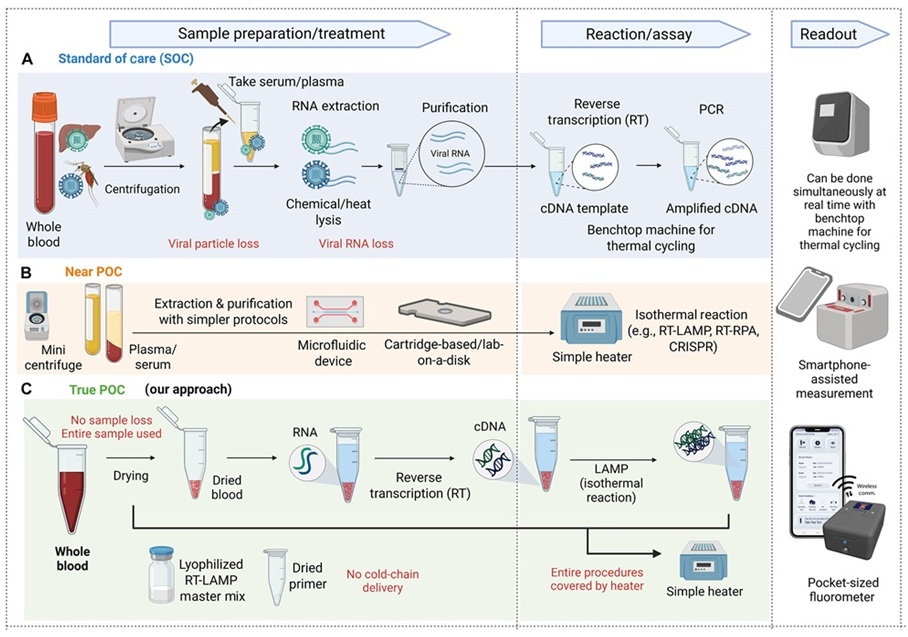
Unlike conventional molecular testing, which relies on purification to remove substances in whole blood that interfere with detection, the new approach eliminates the need for centrifuges and specialized extraction equipment. Rather than miniaturizing existing laboratory procedures, researchers adapted a biphasic reaction strategy to minimize sample loss during processing while maintaining sensitivity at low viral RNA concentrations.
The team also addressed RNA instability in whole blood, where naturally occurring enzymes can rapidly degrade viral RNA, particularly during heat-based processing. The protocol incorporates measures to protect RNA from degradation throughout sample preparation, amplification, and fluorescence-based detection.elerate degradation. The protocol incorporates measures intended to prevent degradation during processing, amplification, and fluorescence-based detection.
The work was described in Science Advances under the title “Amplification of RNA for identification of Zika and HCV in whole blood.” It involved research groups in bioengineering and electrical and computer engineering at Illinois Grainger Engineering. The pocket-sized fluorescence device used to read test results was developed within the electrical and computer engineering research group and is part of a system requiring low amounts of power for point-of-care deployment.
“We needed to come up with a way to prevent degradation at each step of the procedure. In trying so many different combinations, we were able to deduce mechanistic explanations for what works and what doesn't. I think this will lead to a huge leap forward in how we detect other diseases caused by RNA viruses such as Ebola and Lassa fever,” said Jongwon Lim, a former postdoctoral researcher with Illinois Grainger Engineering and current postdoctoral researcher with the Broad Institute of MIT and Harvard.
Related Links
The University of Illinois Urbana-Champaign