AI Tool Predicts Non-Response to Targeted Therapy in Colorectal Cancer
Posted on 16 Apr 2026
Advanced bowel cancer remains difficult to treat, and many patients receive targeted therapies that do not help them but still cause harm. Clinicians need reliable ways to identify likely responders before committing patients to toxic regimens. Researchers now report an artificial intelligence (AI) approach that stratifies patients receiving bevacizumab for metastatic colorectal cancer. The method is designed to direct patients away from ineffective therapy and toward better options.
The approach centers on PhenMap, an AI tool that integrates tumor genomic features with clinical variables such as sex, age, and tumor sidedness to detect biological patterns linked to treatment response. PhenMap narrows broad subtype groupings into more granular patterns and places patients on a continuous scale. A second AI tool then converts these patterns into a prognostic risk score. Patients are assigned to high, moderate, or low risk based on score distribution.
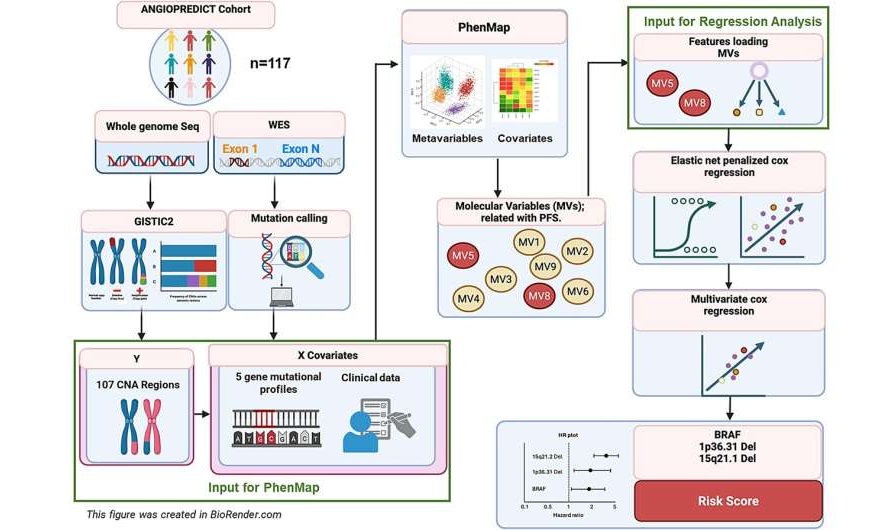
In a study of 117 European patients treated with bevacizumab plus chemotherapy, the highest 10% of scores were designated high risk, the lowest 10% low risk, and the remainder moderate risk. None of the patients in the high‑risk group responded to treatment. The complex feature pattern defining this high‑risk group could serve as a biomarker for identifying likely non‑responders. The analysis also found that patients harboring a BRAF mutation all fell into the high‑risk category and had poor outcomes.
Bevacizumab was approved in December for advanced bowel cancer on the National Health Service (NHS), yet it benefits only a minority and can cause serious adverse effects, including high blood pressure, gastrointestinal problems, and blood clots. The researchers from The Institute of Cancer Research (ICR; London, UK) and RCSI University of Medicine and Health Sciences (Dublin, Ireland) plan to validate the method in additional cohorts and develop it into a test for a prospective clinical trial. They will also explore whether the approach predicts response to other targeted therapies and whether it can be extended to other cancers. The study was published in Scientific Reports on April 13, 2026.
“Our research uses advanced AI methods to pull together large amounts of complex data, helping us to spot patterns that would otherwise be impossible for a human to see, and to uncover the clues hidden within a patient's tumor. In our research, we have shown that this allows us to identify the patients least likely to respond to treatment with bevacizumab," said Anguraj Sadanandam, Professor in Stratification and Precision Medicine at The Institute of Cancer Research, London. "While these findings are encouraging, they will need to be validated in a larger cohort, to ensure they are applicable to all patients. In future, I hope this approach will lead to a test that can be used by clinicians, to ensure patients receive personalized care that has the highest chance of working against their cancer."
"AI has revolutionized cancer research—by enabling us to rapidly analyze large, complex datasets and predict how patients will respond to treatment. This research is a powerful example of how the ICR is leveraging AI to develop smarter, kinder therapies, and deliver them to patients sooner," said Professor Kristian Helin, Chief Executive of The Institute of Cancer Research, London. "This approach also has the potential to be explored in many cancer types, and it will be interesting to see whether the method can predict responses to other targeted therapies across a range of cancer types."
Related Links
The Institute of Cancer Research