AI Tool Predicts Immunotherapy Response Using Tumor Senescence Signals
Posted on 23 Oct 2026
Patients receiving the same cancer immunotherapy can have markedly different outcomes, with some showing little or no response. Identifying these patients earlier could reduce the costs of ineffective treatment and delays in alternative therapy. Differences in the tumor microenvironment, including senescent cells that suppress immune-cell activity, may help explain this variability. Building on this connection, researchers have developed an artificial intelligence method that accounts for tumor cell senescence to predict immunotherapy response.
POSTECH (Pohang University of Science and Technology; Pohang, South Korea) developed a machine-learning method that analyzes genetic information from cancer patients to predict response to immunotherapy. The technology uses a stepwise prediction framework rather than processing all genetic information at once. It first identifies tumors with a senescent microenvironment in which immune-cell activity is suppressed, then progressively stratifies patients as likely responders or nonresponders.
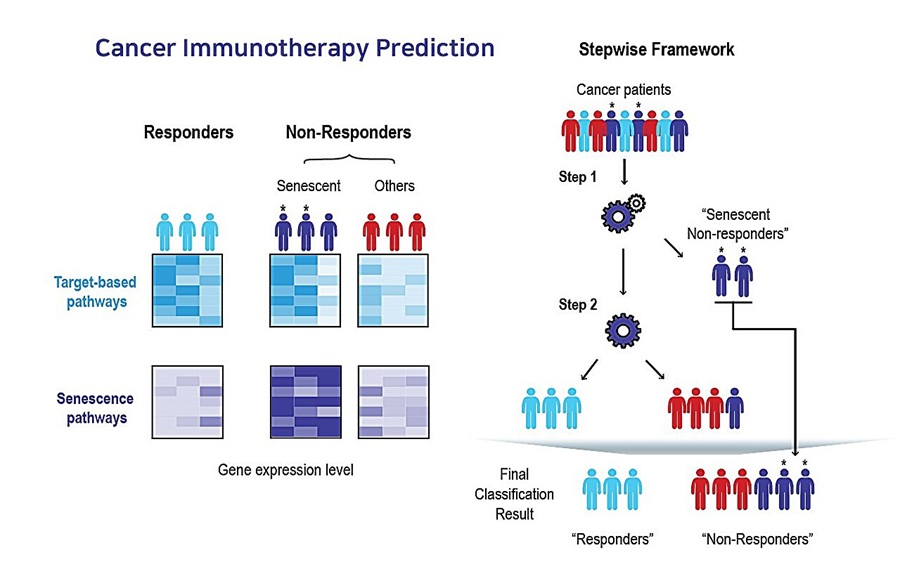
The approach was designed to address a key limitation in artificial intelligence-based prediction: the small number of available patient samples compared with the large volume of genetic information. According to the researchers, this imbalance can cause models to become overly tailored to training data and perform poorly in new patients. The step-by-step method was intended to reduce bias toward any single patient group and support more robust performance across diverse populations.
In experiments, the method outperformed biomarkers currently used in clinical practice for predicting treatment response across four cancer types, including skin cancer, and six patient cohorts. It also showed consistent performance compared with other existing prediction methods when validated in an independent skin cancer cohort that had not been included in model training. The study, titled “Senescence-aware filtering facilitates robust prediction of cancer immunotherapy outcomes,” was published in npj Digital Medicine.
The findings highlight the role of a senescent tumor microenvironment in predicting immunotherapy outcomes. The researchers stated that identifying whether senescent cells may interfere with immunotherapy could support more individualized treatment strategies. The work was conducted at POSTECH.
“By taking cellular senescence into account, this prediction method could help more cancer patients benefit from immunotherapy in the future. Through follow-up studies, we will continue to develop AI-based approaches for predicting treatment response that more precisely reflect the tumor microenvironment,” said Sanguk Kim, professor in the Department of Life Sciences and the Graduate School of Convergence Science and Technology at POSTECH.
Related Links
POSTECH