AI Model Outperforms Clinicians in Rare Disease Detection
Posted on 05 Mar 2026
Rare diseases affect an estimated 300 million people worldwide, yet diagnosis is often protracted and error-prone. Many conditions present with heterogeneous signs that overlap with common disorders, leading to repeated referrals, misdiagnosis, and unnecessary procedures. For many patients, time to a confirmed diagnosis can exceed five years. A new study now shows that an artificial intelligence (AI) system can outperform experienced clinicians in identifying rare diseases earlier and more accurately.
A team led by researchers at Shanghai Jiao Tong University and affiliated institutions has developed DeepRare, an agentic framework for rare-disease prioritization and diagnosis. Rather than relying on a single model, the system coordinates 40 specialized digital tools to analyze diverse inputs, including a patient’s DNA, official medical databases, and handwritten clinical notes. A central AI host orchestrates these components to synthesize evidence and converge on a diagnosis with traceable reasoning.
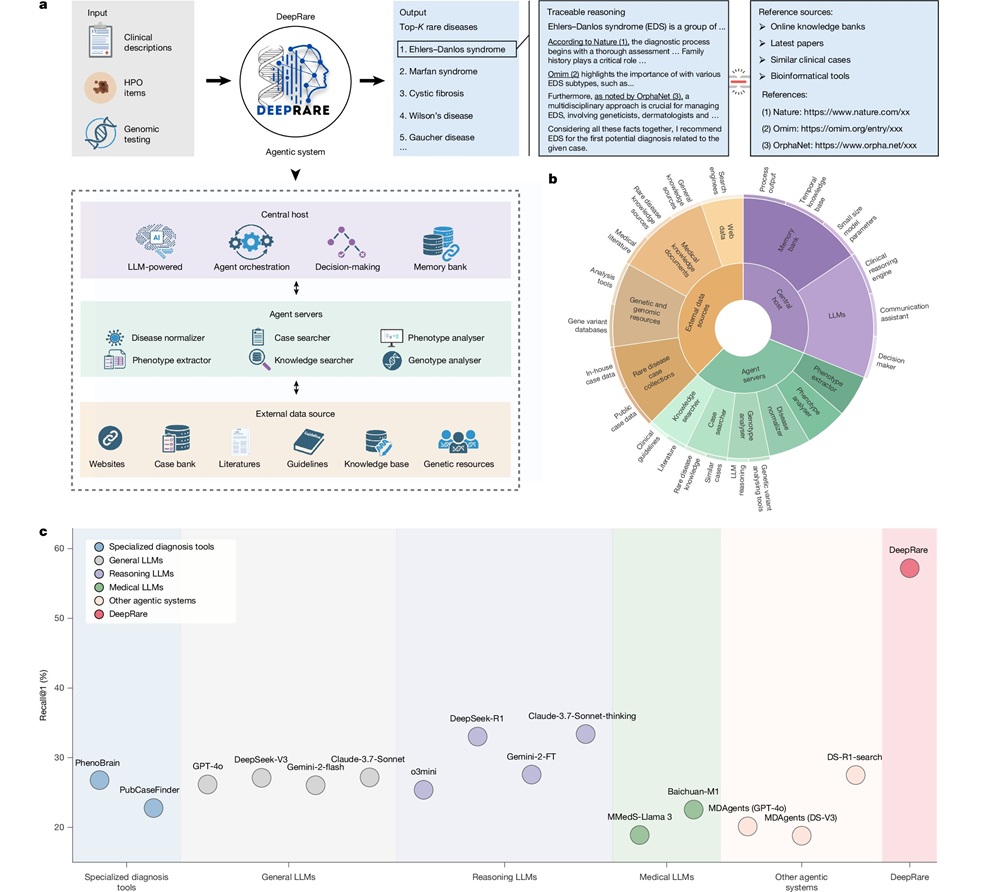
DeepRare was first evaluated on 6,401 clinical cases with known outcomes. Using the same symptom and DNA information available to the original clinicians years earlier, the system could have identified the correct condition earlier in the diagnostic process. In this retrospective benchmark, it also outperformed 15 existing diagnostic systems.
A subsequent head-to-head assessment tested DeepRare against physicians on 163 difficult cases. Five experienced doctors, each with more than a decade of practice, received the same data as the system. DeepRare achieved a 64.4% top-1 diagnostic accuracy on the first attempt, compared with 54.6% for the physicians.
Even when not exactly correct on the first try, the model’s Recall@3 indicated that the right diagnosis was usually among its top three suggestions. Ten rare-disease specialists reviewed the system’s step-by-step reasoning and agreed with its logic 95.4% of the time. The findings were detailed in a study published in Nature on February 18, 2026.
"DeepRare is one of the first computational models to surpass the diagnostic performance of expert physicians in the complex task of rare-disease phenotyping and diagnosis," stated the study's authors. "Our work not only advances rare disease diagnosis but also demonstrates how the latest powerful large-language-model-driven agentic systems can reshape current clinical workflows."
Related Links:
Shanghai Jiao Tong University



.jpg)