Two-Step Blood Testing Approach Reduces Uncertainty in Amyloid Assessment
Posted on 21 Oct 2026
Blood-based biomarkers offer a more accessible, less expensive way to detect Alzheimer’s-related brain changes than traditional methods such as amyloid-beta positron emission tomography (Aβ-PET). However, results are not always definitive. Even a promising marker such as p-Tau217 can leave patients in a diagnostic gray zone, requiring brain imaging to clarify amyloid status. To reduce this uncertainty, researchers have developed a two-step blood-testing strategy that may help resolve inconclusive results.
Researchers at Boston University Chobanian & Avedisian School of Medicine, working with the University of Connecticut, developed and tested the Gatekeeper-Reflex model for Alzheimer’s disease (GRAD). The model uses a second blood-testing step when the initial result does not clearly indicate whether amyloid, a key feature of Alzheimer’s disease, is present. This sequential approach aims to clarify uncertain findings while reserving further testing for patients who need it.
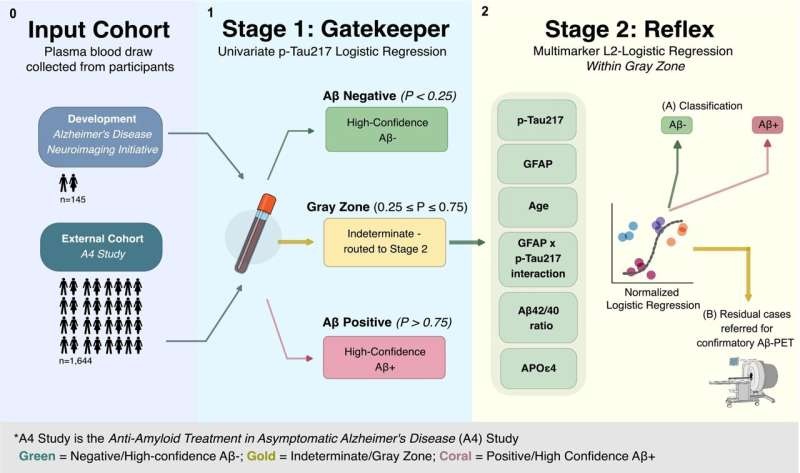
The model first evaluates p-Tau217 results. If the blood test provides a clear result, no additional testing is needed. If the result falls into the gray zone, GRAD considers additional blood biomarkers together with factors such as age and genetic risk.
The researchers developed GRAD using data from 145 people with memory or thinking problems who participated in the Alzheimer’s Disease Neuroimaging Initiative. All participants had blood biomarker measurements and an amyloid PET brain scan, which served as the reference for determining amyloid status. The team then tested the same approach in an independent group of 1,644 cognitively unimpaired participants from the A4/LEARN studies.
Among 630 participants with gray-zone p-Tau217 results, GRAD improved the ability to identify amyloid and reduced the proportion of participants who would still need PET imaging. The paper was published in Annals of Clinical and Translational Neurology on October 19, 2026. Other participating institutions included the University of California Irvine, Mass General Brigham, Harvard Medical School, and Yale School of Medicine.
The researchers cautioned that GRAD is not ready to replace confirmatory imaging and still needs prospective testing before routine clinical use. They also stated that a blood-first approach could make accurate Alzheimer’s testing easier to reach and reduce the need for expensive scans or invasive procedures when a clear answer is needed. The approach may also be useful for Alzheimer’s prevention and treatment trials that require identification of people with brain amyloid from large groups of potential participants.
“GRAD does not try to replace a good Alzheimer's blood test. Instead, it focuses additional testing specifically on the people for whom the first blood test does not give a clear answer. This creates a practical 'test first, investigate further only when needed' approach that more closely resembles how clinicians make decisions in the real world,” said Harthik Parankusham, a student in the department of physiology and neurobiology at the University of Connecticut.
Related Links
Boston University Chobanian & Avedisian School of Medicine
University of Connecticut